
News
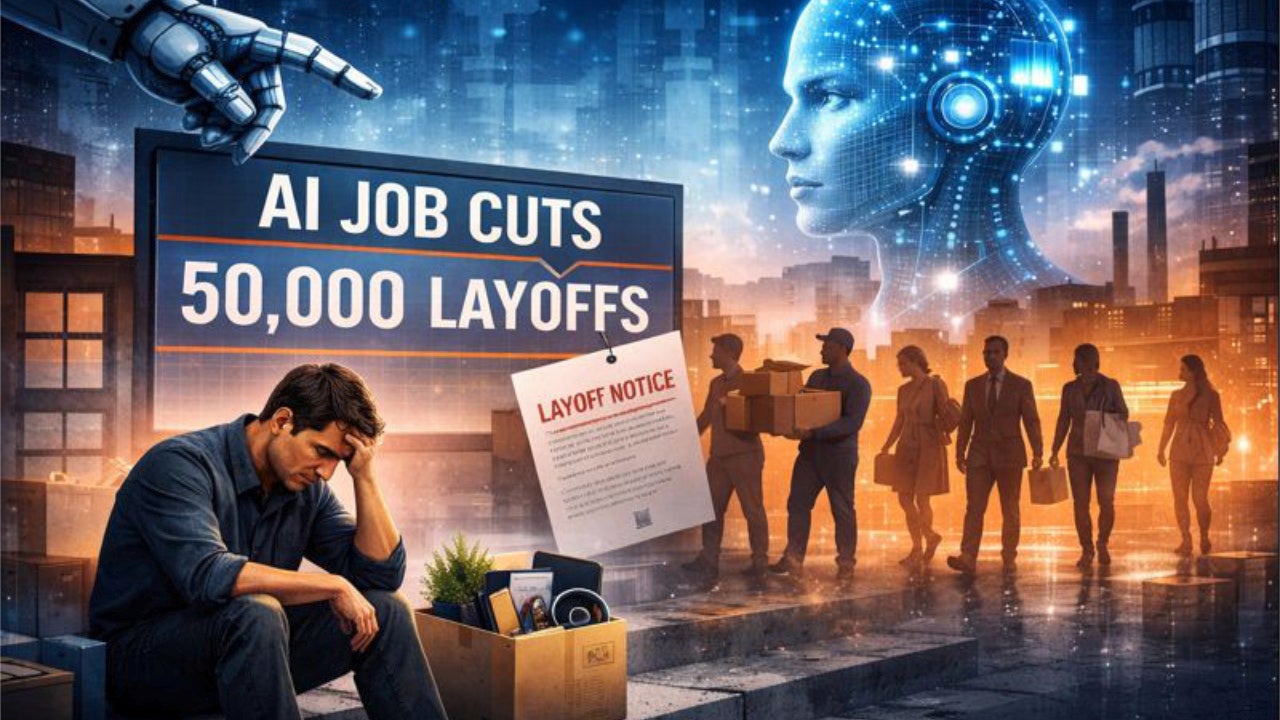
AI has been responsible for 50,000 layoffs in 2025: what can we expect in 2026?
A trend that will go further or an excuse that has lost strength?

- December 22, 2025
- Updated: December 22, 2025 at 3:39 PM
Saying that 2025 has been a year defined by major shifts in the labour market is probably an understatement, especially in the tech sector. According to data from consultancy Challenger, Gray & Christmas, reported by CNBC, artificial intelligence has been cited as the cause of nearly 55,000 layoffs in the United States, in a year in which total cuts have affected more than one million workers. For many companies, AI has become a way to optimise resources, but also to reorganise teams in pursuit of greater efficiency. Given this scenario, what can we expect from 2026?
The major companies attributing layoffs to artificial intelligence
Over the past few months, several of the biggest tech companies have announced massive headcount reductionsdirectly linked to the rollout of AI. The most notable include:
- Amazon: In October, the company carried out the biggest round of layoffs in its history, cutting 14,000 corporate roles. According to Beth Galetti, Senior Vice President of People Experience and Technology, the company aimed to operate with more agile structures to take advantage of what it considers the most transformative generation of AI since the invention of the Internet.
- Microsoft: It has eliminated around 15,000 jobs in 2025, including 9,000 last July. Satya Nadella explained that the goal is to reimagine the company’s mission in the AI era, moving towards a development model more focused on intelligent creation tools.
- Salesforce: In September, Marc Benioff confirmed the cut of 4,000 customer service positions, stating that AI is doing up to 50% of the work at the company and that this allows them to operate with fewer staff.
- IBM: The company has replaced several hundred employees in human resources roles with AI chatbots, although it has increased hiring in software engineering and sales areas.
- CrowdStrike and Workday: Both firms announced layoffs of 500 and 1,750 employees respectively, explaining that investment in AI is key to staying competitive.
All these moves reflect a broader trend: companies are reorganising their teams to bet on automation and the efficiency that artificial intelligence enables.
What to expect in 2026
Looking ahead to next year, analysts expect companies to continue integrating artificial intelligence into more areas of their day-to-day operations, from customer support to data management. It’s the same strategy we’ve already seen, and it could lead to a further reduction in traditional roles, but it may also open up new opportunities in areas such as model development, systems security, and oversight of automated systems.
The MIT study published in November 2025 states that AI could cover 11.7% of the US labour market and generate savings of up to one trillion dollars in wages, especially in sectors such as finance, healthcare, or professional services. With “savings” being the key word for companies, in 2026 we may see more organisations reshaping their talent to adapt to the era of artificial intelligence.
AI as a cause, but also as an excuse
Although artificial intelligence has been cited as the official reason behind tens of thousands of layoffs, we shouldn’t overlook the fact that many companies are using AI as a rationale for adjustments that actually respond to other factors. Fabian Stephany, from the Oxford Internet Institute, explained that several of the companies mentioned above hired very aggressively during the pandemic and are now going through a workforce correction process, where they find in AI a convenient justification in front of the market and investors.
In that sense, the situation may not be as worrying in 2026, with most of the headcount corrections already carried out and with a gradual realisation that artificial intelligence cannot fully take over many processes. As we know that oversight is becoming increasingly important, the efficiency gains are something companies will need to weigh carefully when implementing their strategy. In any case, balancing automation with the creation of new roles will be the key this new year—one in which we may be in for surprises as far as the labour market is concerned.
Architect | Founder of hanaringo.com | Apple Technologies Trainer | Writer at Softonic and iDoo_tech, formerly at Applesfera
Latest from David Bernal Raspall
You may also like
 News
NewsThe showrunner of The Simpsons says you won't find out when the series will end while you're watching it
Read more
 News
NewsSteam has a negativity problem that is affecting its players
Read more
 News
NewsBelén Rueda explains why the ending of Los Serrano was so peculiar
Read more
 News
NewsThe fourth installment of The Mummy with Brendan Fraser and Rachel Weisz now has a release date
Read more
 News
NewsFilmin brings back a cult classic by Jack Nicholson and Jennifer Lopez that is now forgotten and you shouldn't miss
Read more
 News
NewsThe studio behind Disco Elysium will release a temporary demo of its next game in the coming days
Read more