

WireGuard and Tailscale are often mentioned together and for good reason. WireGuard is a fast, minimal VPN protocol built with a small codebase and modern cryptography. Because of this strong backbone, it has become the foundation for many VPN solutions, often used for services like Tailscale, NordLayer, and Netbird. Tailscale, in particular, is a managed mesh VPN that is built on top of the WireGuard protocol, delivering secure connections without the hassle of manual configuration.
While WireGuard provides you with the cryptographic foundation and tunnel, the rest is up to you. You must configure key distribution, NAT traversal, and access controls on your own, giving you total control. But this type of setup may be complex, especially in enterprise environments. So Tailscale fills in those gaps for you, automating everything that WireGuard does not, including NAT traversal, peer discovery, IP assignment, and access control.
Choosing between the two requires you to consider what you desire more: control or convenience. If you need an easily-configured VPN, Tailscale is ideal. However, if you need more control over the infrastructure or want to embed a custom VPN, WireGuard is the better choice.
We researched the details of the components of each service so we could break down the strengths of both tools in this article. This article compares the performance, architecture, ease of use, and features of Tailscale and WireGuard as well as shares VPN alternatives so you can find the best fit for your company.
What option to choose?

Is WireGuard or Tailscale Right for You?
|
Priority |
WireGuard |
Tailscale |
|
Speed |
✅ Kernel-accelerated tunneling |
⚠️ Slight overhead via coordination server (DERP/STUN) |
|
Ease of Setup |
❌ Manual configuration |
✅ Zero-config |
|
Self-Hosting |
✅ Fully self-managed |
⚠️ Available through third-party Headscale |
|
Encryption |
✅ ChaCha20, Curve25519, Poly1305 |
✅ ChaCha20, Curve25519, Poly1305 |
|
Price |
✅ Free and open source, but requires infrastructure |
❌ Business plans start at $6/user/month |
|
NAT Traversal |
❌ Requires extra tooling (STUN, port forwarding) |
✅ Built-in with fallback relays (DERP) |
|
DNS Routing |
❌ Manual configuration |
✅ MagicDNS included |
|
Identity-Aware Authentication/SSO |
❌ Public/private key pairs |
✅ OAuth, SAML, ACLs, device tagging |
|
UI |
❌ Third-party GUI |
✅ Web interface |
WireGuard Is Slightly Faster, but Both Are Strong Options
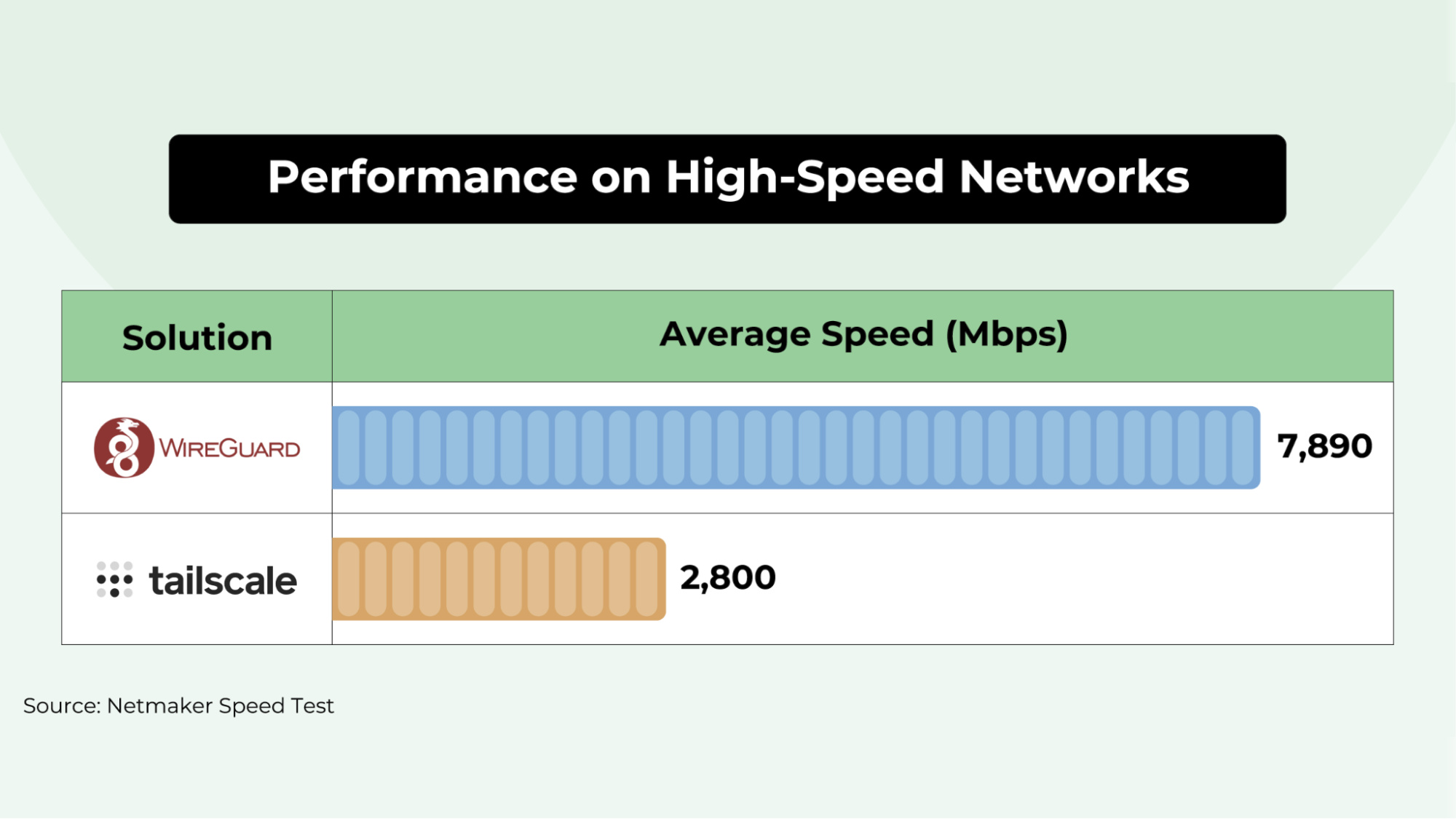
WireGuard is known for speed, thanks to its lightweight codebase, which comes in at around 4,000 lines. WireGuard’s modern cryptography and support for kernel-level integration also help increase speeds. It consistently tops speed and performance tests with a self-reported 1,100 Mbps throughput and 0.403 ms ping time. In high-performance environments, other speed tests have shown 7,890 Mbps and data transfer speeds of 7.89 Gbits/sec. Compare that to the 2,800 Mbps and 5.25 Gbits/sec data for Tailscale.
Tailscale’s performance is excellent for most everyday cases, but the design of its routing can impact speed. If a direct peer-to-peer connection can’t be established, it falls back to using relay nodes (called DERP servers), which are designed for reliability, not throughput. This makes Tailscale reliable across firewalls, but it can also significantly reduce throughput in high-performance environments. This is because DERP servers will limit throughput to make sure that everyone using the DERP server has the same kind of speed.
Regardless of how it compares to WireGuard, Tailscale is still significantly faster than many other VPN options like OpenVPN and ZeroTier.
Tailscale Is Easier to Set Up
Tailscale is known as a user-friendly solution, as the network can be set up in minutes. All you need to do is download and install the Tailscale client, sign in with an SSO identity provider, and add devices to the tailnet. The admin consoles allow you to easily control permissions and authentication keys.
Unlike Tailscale, WireGuard requires more manual configuration during the setup process.
You must download the installer for your platform, choosing between Windows, macOS, Linux, iOS, or Android. Then, you have to generate key pairs, share public keys between peers, assign static IPs, and create config files on both sides. You’re also responsible for firewall and NAT traversal setup, IP management, and port forwarding. This process is more complex and requires some technical expertise, but you’ll be able to customize WireGuard to your exact needs.
Tailscale is the clear winner between the two if you’re looking for a VPN solution that is easy and quick to set up.
WireGuard Is Self-Hosted
Self-hosting WireGuard takes more effort to set up, but offers significant benefits such as full control over infrastructure, high customizability, and freedom from third-party access to your data. Tailscale manages coordination, identity, and NAT traversal through its proprietary control plane, but WireGuard gives you total ownership of how peers connect and authenticate. Self-hosting WireGuard can be ideal for compliance-heavy or security-sensitive environments, where full control over networking and data flow is essential. Keep in mind that configuration and deployment should be handled by someone with experience to avoid security misconfigurations.
Tailscale does not offer an official self-hosted mode, but you can use Headscale, which is an open-source version of Tailscale’s coordination server. It offers many of the same features without relying on Tailscale’s coordination server, but it does lack some functionality, like a polished admin UI and device posture checks.
Both Offer Strong Security and Encryption
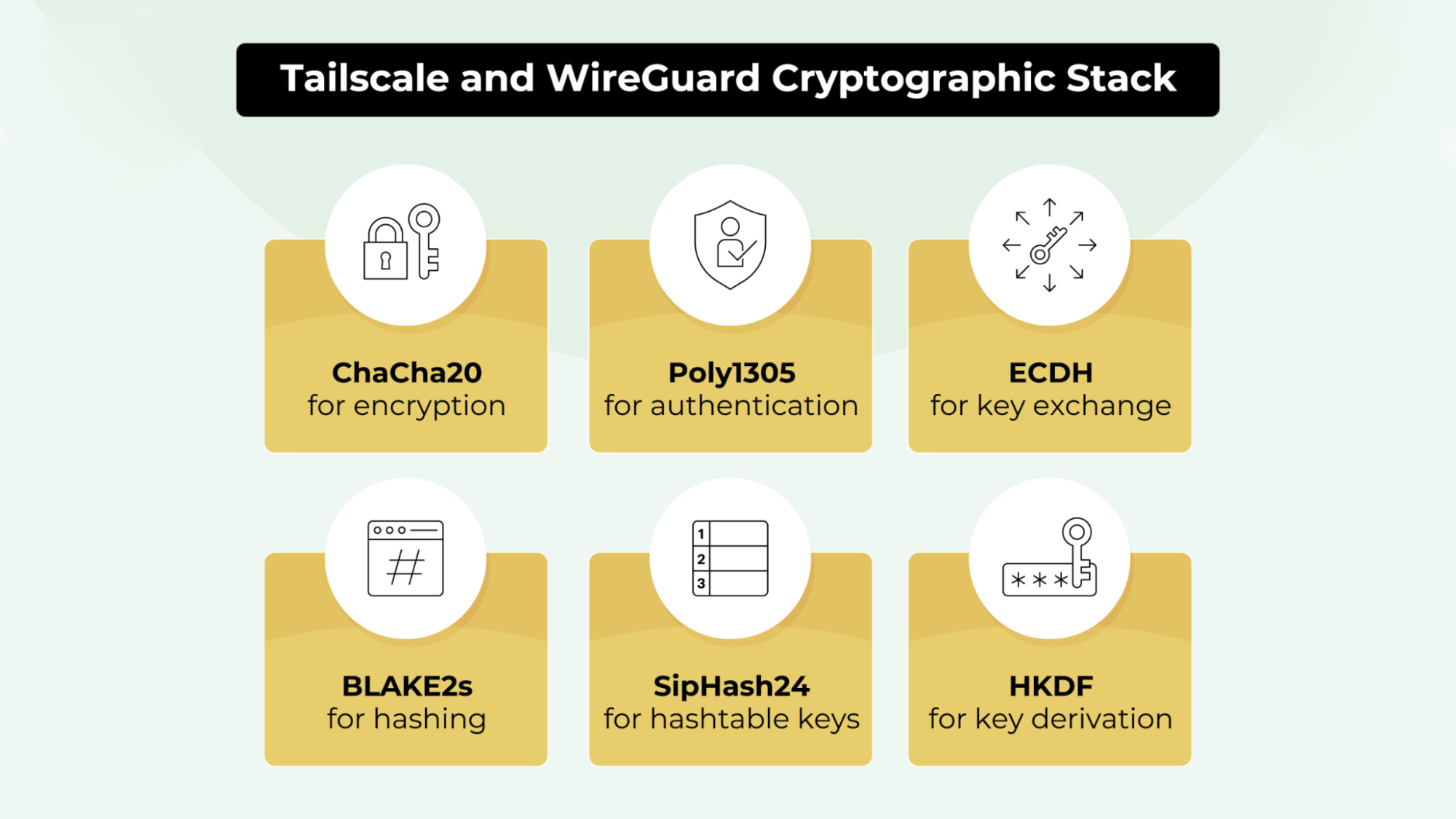
Both Tailscale and WireGuard use the same secure cryptographic suite. This includes ChaCha20 for encryption, Curve25519 for key exchange, Poly1305 for message authentication, BLAKE2s for hashing, and HKDF for key derivation. However, Tailscale goes a step further and adds security features like SSO and MFA, access control lists (ACLs), user roles, and device posture checks. Both WireGuard and Tailscale are strong choices, as Tailscale offers more built-in security features, while WireGuard provides a clean, easily auditable protocol layer.
WireGuard Is Free and Lightweight, but Requires Infrastructure
WireGuard is free and open source under the GPLv3 license, meaning you can use it commercially or privately and modify the code for your individual needs. However, you’ll still need to provide your own infrastructure to run it, which usually means renting or maintaining a cloud server or hosting it on your own hardware, like a router. While a bit more difficult to set up, WireGuard could be less expensive than paying a monthly, per-user fee.
In comparison, Tailscale offers a free forever plan for personal use up to 3 users. The Personal Plus Plan starts at $5/user/month, the Starter Business Plan starts at $6/users/month, and the Premium Business Plan with more advanced features starts at $18/user/month. While it takes less effort to set up Tailscale, it could prove to be more expensive in the future.
Tailscale Offers Automatic NAT Traversal and DNS Routing
Tailscale’s NAT traversal is important because it allows for seamless peer-to-peer device connectivity, even through firewalls and complex network environments. It will try to make a direct peer-to-peer connection using STUN and UDP hole punching. If that fails, it falls back to DERP relay servers to ensure a connection is always established. While this makes Tailscale’s network reliable, DERP comes with a performance tradeoff through additional latency and bandwidth limits.
Tailscale also includes MagicDNS, which will register stable, human-readable DNS names for every device in the network. This eliminates the need to manually assign IPs or manage DNS servers. It simplifies network management and improves usability, especially across multi-device environments.
On the other hand, WireGuard does not include built-in NAT traversal or DNS management.
To get peer-to-peer connectivity, users must manually configure port forwarding, open firewall ports, and ensure each peer can reach others over public or static IPs. DNS is also manual, as administrators typically must assign a static IP for each peer, manually edit scripts, and deploy a local DNS server. This can be complex, especially in dynamic or multi-site networks where endpoints frequently change.
Talisale Offers Identity-Aware Authentication
Tailscale’s identity-aware networking increases security by tying access to user identities, not just devices or IP addresses. It also supports Zero Trust networking, which is based on verified identity and device posture, allowing organizations to enforce least-privilege access, audit control, and user-based segmentation across devices, even on untrusted networks. It can also integrate with existing identity providers like Apple, Google Workspace, GitHub, Microsoft, Okta, and OneLogin to authenticate users. The access control lists allow you to decide which users, groups, IP addresses, or hosts can connect within your network.
Contrast this with WireGuard, which has no built-in concept of identity, users, or roles. It is simply a peer-to-peer tunnel that is secured by manually exchanged keys. Admins have to manually implement user controls through firewall rules or third-party tools.
Tailscale Has a Better UI
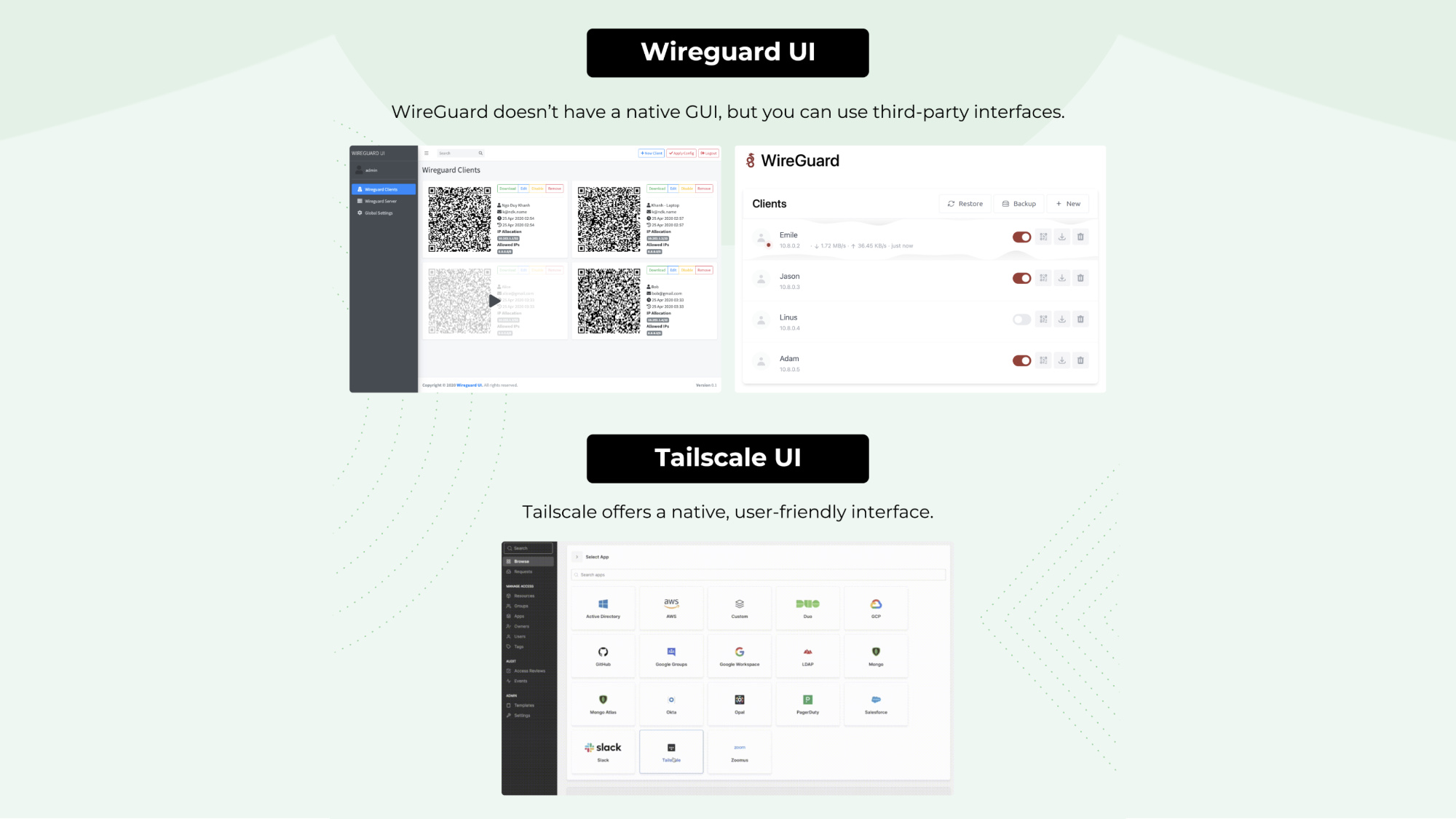
Tailscale has a user-friendly web interface that allows you to configure settings and manage devices without using a command line. It also has a mobile version with apps for Android and iOS, making it easy to connect or manage on your smartphone. For advanced users, Tailscale has a command-line interface, but most tasks can be completed through the admin console.
WireGuard does not have a built-in GUI. Configuration has to be done through the terminal, manually editing files, or using third-party tools. For example, WireGuard Easy or WG-Easy can give you a web-based UI that streamlines configuration and is deployed through Docker. Overall, this is much more technical than Tailscale.
WireGuard and Tailscale Use Cases
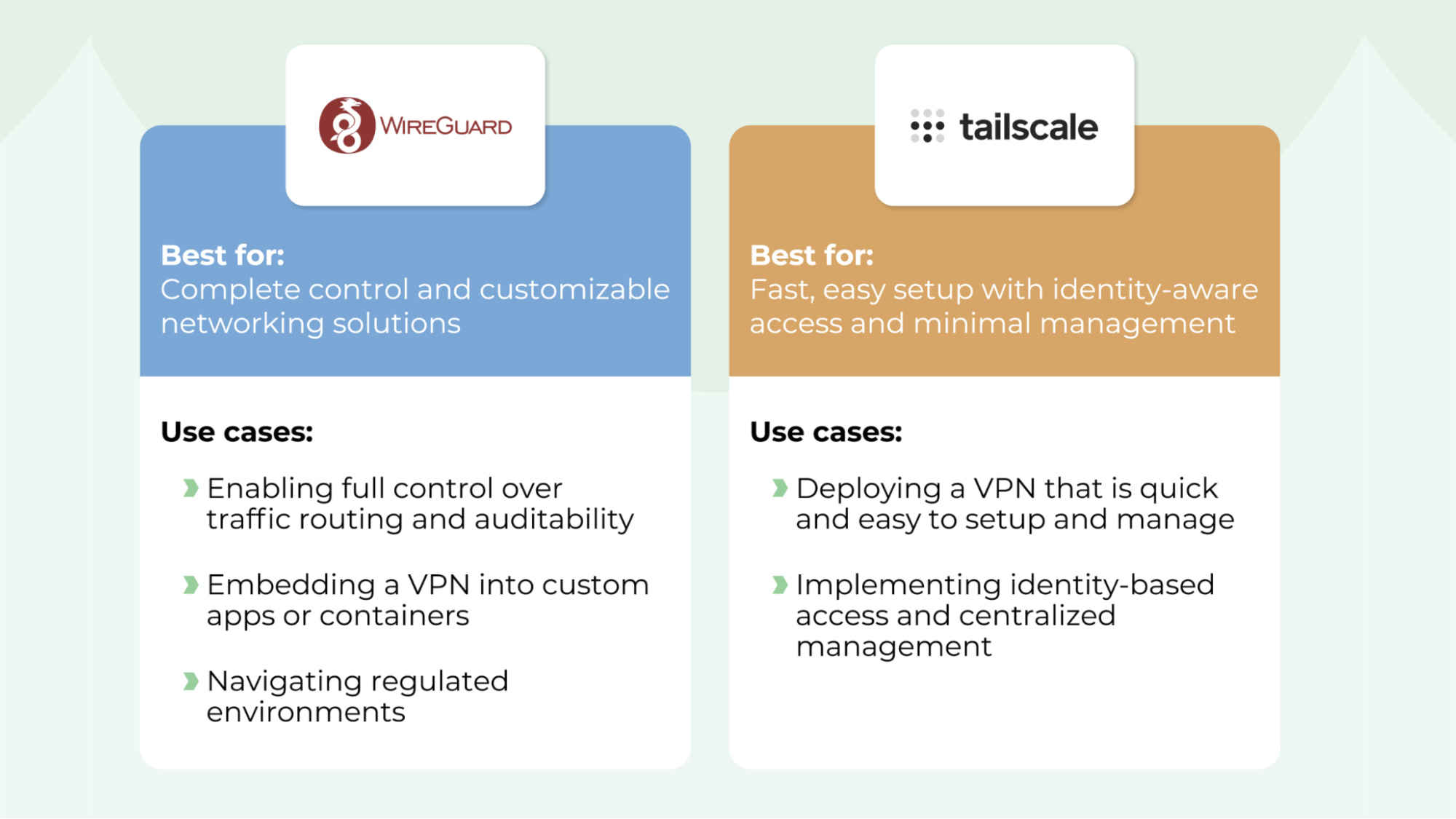
WireGuard and Tailscale both offer secure, high-performance networking. However, each will be optimal for different individual cases.
WireGuard Is a Strong Fit for:
- Developers embedding a VPN into custom apps or containers
- Infrastructure engineers managing site-to-site tunnels or edge networking
- Security teams that need full control over traffic routing and auditability
- Regulated environments where third-party dependencies aren’t acceptable
Tailscale Is a Strong Fit for:
- Organizations looking for a VPN that is quick and easy to set up and manage
- Remote or hybrid teams that need quick, secure access to internal apps or dev environments
- Organizations that want identity-based access and centralized management
VPN Alternatives to Tailscale and WireGuard
If you’re still exploring your options, several other modern VPN tools balance performance, privacy, and usability. Some focus on total self-hosting, others offer managed services, and some offer both. Many are based on the WireGuard protocol or give you the option between WireGuard and other popular protocols like OpenVPN or IPsec (IKEv2).
Fully Self-Hosted VPNs
Just like WireGuard, these solutions require manual configuration, giving you complete control but requiring technical expertise. Both are more flexible than WireGuard, but also more complex to set up.
OpenVPN Community Project
OpenVPN is also an open-source VPN protocol. It is slower than WireGuard, but it is also a more mature and flexible protocol that supports TCP and UDP tunnels, advanced firewall traversal, and robust certificate-based authentication. It is more advanced to set up, but it could be a good solution if you need more fine-grained control or operate on legacy platforms.

SoftEther VPN
SoftEther is an open-source VPN solution that includes protocols such as SoftEther VPN Protocol, L2TP/IPsec, MS-SSTP, OpenVPN, and EtherIP. It can support advanced features like NAT traversal, dynamic DNS, and Secure Socket Layer (SSL) encryption, which ensures secure connections. SoftEther is highly flexible, but it is complex to configure and maintain compared to WireGuard and OpenVPN. It also offers slower performance than WireGuard due to its broader feature set. However, SoftEther is still a good fit if you need multi-protocol support, strong firewall traversal, or operate in restricted network environments.

Self-Hosted or Managed Options
These tools use WireGuard, but they also add identity-based access control, NAT traversal, and web consoles. They offer both self-hosted and managed deployment options.
NetBird
NetBird is a modern WireGuard-based VPN solution that combines the raw speed and security of WireGuard with the ease of use found in tools like Tailscale. It uses the kernel WireGuard module on Linux systems, and both the client agent and the coordination server are open source. This gives users full transparency and the option to self-host their entire network fabric.
For those who don’t want to manage or set up infrastructure, NetBird offers a managed service with secure remote access features like user and group provisioning and network segmentation. NetBird is also relatively cheap, starting at $5 per user per month. However, NetBird has a smaller ecosystem and fewer third-party integrations than Tailscale, and it isn’t as mature.
NetBird may be a good option if you want full control over your network, especially on Linux systems where it leverages the kernel WireGuard module, and the ability to run your own open-source coordination server.
Netmaker
Netmaker is also a high-performance, mesh VPN that uses kernel WireGuard and supports both self-hosted and managed deployments. However, unlike Tailscale or NetBird, which focus on ease of use and GUI simplicity, Netmaker is built for complex networks and deep infrastructure integration.
Netmaker allows users to create custom networks with private IP segments, which provides greater flexibility and control over network configuration. It also includes multi-network segmentation, network egress, dynamic relay, access controls, and DNS. You can use automation to change configurations and push network updates. Netmaker uses a tiered pricing model, where pricing and fees are based on the number of connections and networks.
Unfortunately, Netmaker doesn’t have as many integrations as Tailscale and is much more complex to set up. It is not beginner-friendly, but it may be a good fit if you’re managing multi-cloud or edge infrastructure, need advanced mesh routing, or want a programmable networking layer.

Fully Managed VPNs
These are cloud-hosted VPN providers with user-friendly interfaces and minimal infrastructure setup.
NordLayer
NordLayer is a multi-protocol business solution that combines an always-on VPN with security features like threat protection and threat intelligence. It supports both OpenVPN and NordLynx, and NordLayer’s proprietary protocol based on WireGuard that delivers enhanced speeds and stronger encryption.
NordLayer is extremely easy to deploy and manage, with centralized user and device management, making it ideal for businesses without large IT teams. While it is more expensive than other VPN solutions, starting at $8 per user per month for the Lite Plan up to $14 per user per month for the Premium Plan, it offers a comprehensive security suite that goes beyond just basic VPN functionality.
NordLayer is best for businesses that need simple, scalable, and secure remote access without the complexity of a full security stack.

OpenVPN CloudConnexa
CloudConnexa is OpenVPN’s fully managed, cloud-based VPN solution, which offers the stability and configurability of the OpenVPN protocol without having to set up your own servers.
It includes features like location context policy, device posture, access control, secure web gateway, intrusion detection and prevention, SCIM support, DNS logs, and more.
While it doesn’t support WireGuard and tends to be slower than newer VPN protocols, CloudConnexa excels in environments where reliability, protocol flexibility (TCP/UDP), and detailed policy control are more important than raw speed. It’s a good fit for organizations with strict firewall requirements, legacy systems, or compliance-driven needs.

What option to choose?
The Final Verdict: WireGuard vs. Tailscale
Whether you're building infrastructure from the ground up or looking for a plug-and-play VPN, both Tailscale and WireGuard offer exceptional performance and security. If your team needs fast rollout, entity-aware access, and minimal management, Tailscale is likely the better fit. However, if you need complete control over networking or want to craft a custom solution, WireGuard may be the better choice. Whether you decide between WireGuard or Tailscale or use a VPN alternative, there are plenty of VPN options to choose from that can best fit your individual needs.