
What Is The Future of AI? Stats and Trends 2024
Looking for a ChatGPT alternative? These are the current AI stats and trends of 2024


- October 30, 2024
- Updated: July 1, 2025 at 10:48 PM
AI (Artificial Intelligence) is one of the most exciting and controversial technology feats of the 21st century. Its growth and influence seem to find no limit, having a strong impact in industries of all sorts. The rapid artificial intelligence evolution led to shaping a new kind of generative AI that can reason, understand and create like a human being. From ChatGPT to autonomous vehicles, AI is bound to shape the future and change society in the years to come. But, what can we expect from it?
In today’s article we’ll take a closer look at AI’s top trends and statistics in 2024, answering key questions like how big is the AI space, how quickly is growing and where is it leading to.

Subscribe to the Softonic newsletter and get the latest in tech, gaming, entertainment and deals right in your inbox.
Subscribe (it's FREE) ►Top AI Statistics
- The global AI market is valued at over $196 billion.
- The AI market is expanding at a CAGR (Compound Annual Growth Rate) of 38.1% between 2022-2030.
- AI market size is expected to reach $1339 billion by 2030.
- It is forecasted that by 2025, 97 million people will work in the AI workspace.
- 83% of companies expressed that AI is currently the top priority of their business plans.
- 78% of businesses have adopted AI for at least one business function.
- Over 75% of consumers are concerned about misinformation from AI.
- 77% of people are concerned that AI will cause job loss in the next year.
- 64% of businesses expect AI to increase their productivity.
Artificial Intelligence Market Size
According to a recent survey made by Grandviewresearch, the global AI market is worth $279 billion, $80 billion more than in 2023. That’s a 29% increase in just a single year. Over the next 6 years, the AI market is set to grow by over 13x, increasing by a CAGR of 37.7%.
Global AI Market Revenue
In 2024, the AI software market global annual revenue stands at around $100 billion ($94.41b). A recent study made by Omdia forecasts a very brilliant future for AI, achieving an exponential growth of 25% from 2024 to 2025.
Here’s a breakdown of the AI market global revenue from 2018-2015:
- 2018: $10.1 billion
- 2019: $14.69 billion
- 2020: $22.59 billion
- 2021: $34.87 billion
- 2022: $51.27 billion
- 2023: $70.94 billion
- 2024: $94.41 billion
- 2025: $126 billion
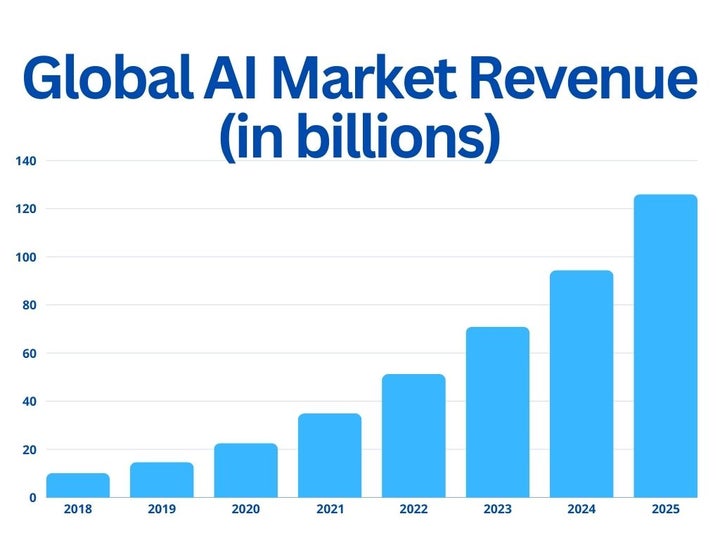
These numbers are also supported by a study made by Omdia. It states the AI service revenue will increase by 6x in the space of 5 years. That means that in 2020, AI services will generate $19.4 billion, in 2022 will grow to $62.5 billion and by 2025, it will reach $126 billion in annual revenue.
It’s interesting to point out how in terms of revenue, North America accounted for 30.9% of the global intelligence market in 2023.
AI Growth and How it Affects the Market
AI’s popularity is growing exponentially year after year and this growth is unlikely to stop. If we look at the data, in 2015 just 10% of organizations used or planned to use AI in their business. As shown by a study made by Gartner, in 2019, the tables turned and the number of companies using AI services grew by 270%. Nowadays, 7 in 20 organizations use AI in their daily routines. That’s 35% of companies worldwide.
As seen by a study made by Grand View Research, the global adoption of AI is growing at a CAGR (Compound Annual Growth Rate) of almost 40%. A recent survey shows how most companies that were thinking of investing in AI in 2018 already are using it in 2019.
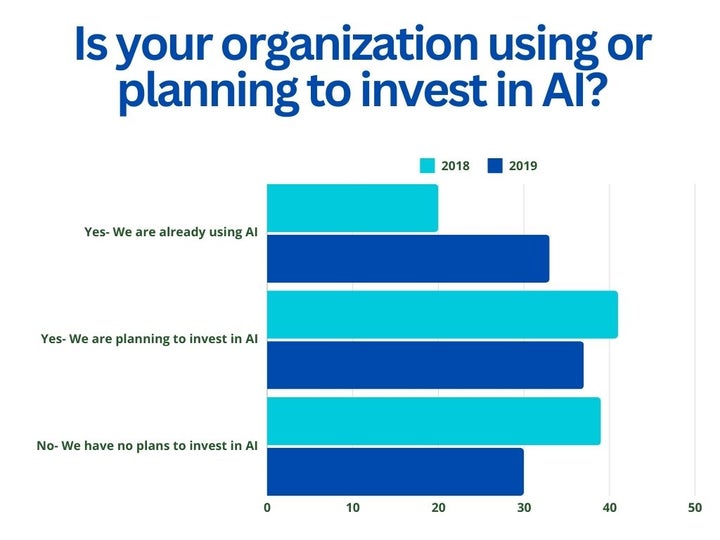
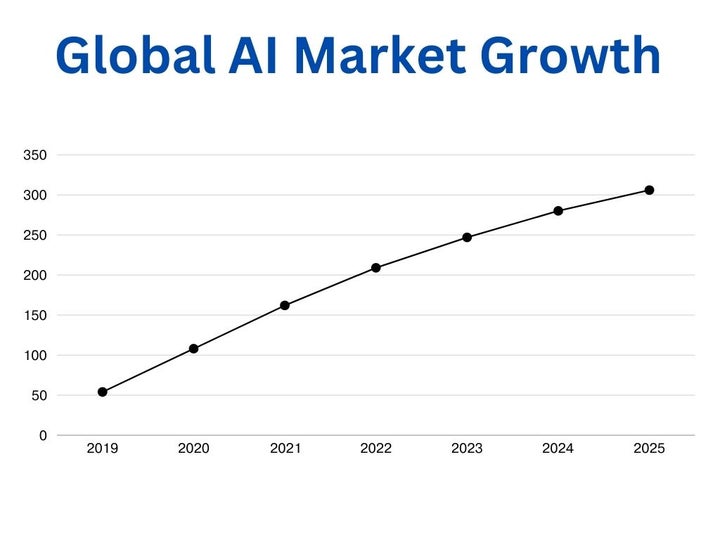
A recent study made by Tractica supports these facts, stating how between 2021 and 2022 the AI market grew 47%. This trajectory has been forecasted to grow year after year at least 26% until 2025.
AI market growth:
- 2019: 54%
- 2020: 54%
- 2021: 54%
- 2022: 47%
- 2023: 38%
- 2024*: 33%
- 2025*: 26%
(*estimated)
How Businesses Are Adopting Artificial Intelligence
According to Forbes, around 4 in 5 companies stated that AI is one of their current top business strategies. In fact, 83% of companies are currently using AI in the form of chatbots or as means to write automated emails, making everyday communications more productive and agile.
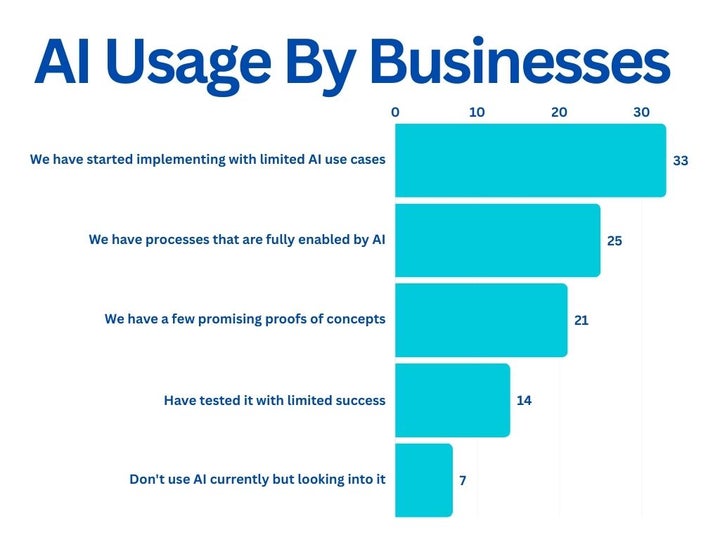
PWC’s 2024 AI business predictions state that around 17 in 20 CEOs agree that AI and their business go hand-in-hand, making their company more productive. That’s a whopping 86% of the total. The same study also states that said productivity has the potential to be improved by 40% by 2035.
A 2019 survey made by Gartner shows how the key AI applications to businesses is providing product recommendations as well as bringing pop-up marketing ads as well as chatbots. The same source also shows how the average number of artificial intelligence or machine learning projects have been rising exponentially since 2019.
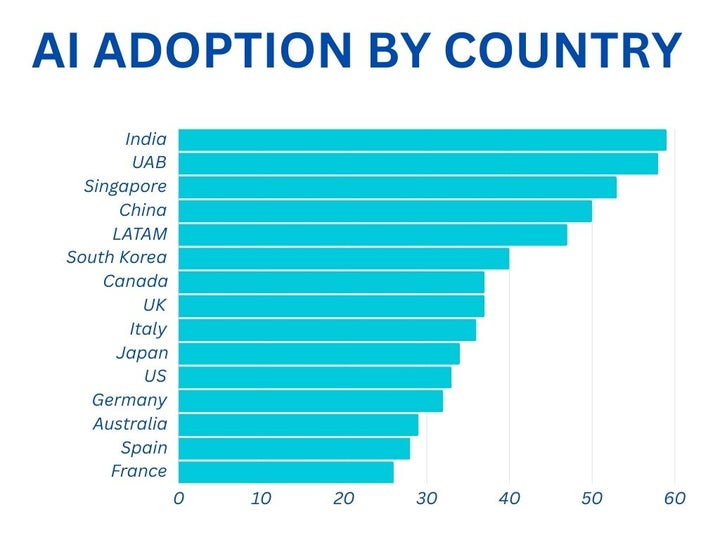
AI Adoption Rate by Country
As seen by a recent survey by Statista, AI adoption rate is higher for businesses and organizations in India (59%), followed by the United Arab Emirates (58%), Singapore (53%) and China (50%). Western countries, in particular European ones such as Spain (28%) or France (26%) have been slower to try AI.
What Is The Most Popular AI Tool? ChatGPT Alternatives
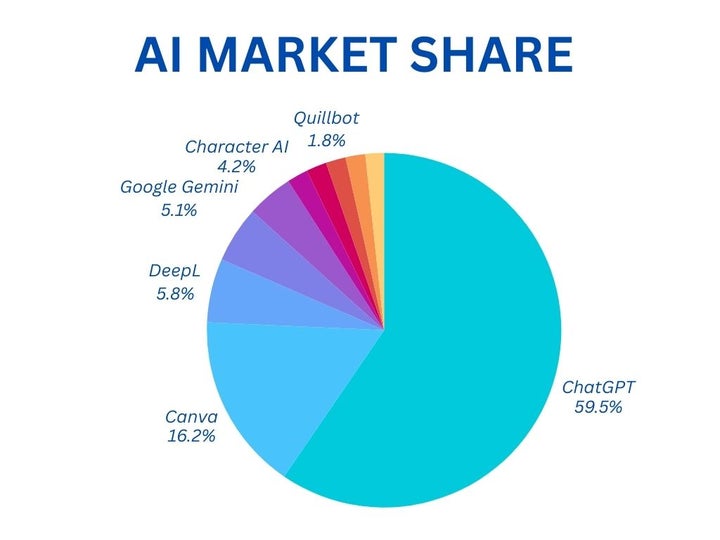
As of October 2024, the most popular AI tool in the world is OpenAI’s ChatGPT. The generative artificial intelligence receives 3.1 billion visits per month and gets over 54% of the market share. Other popular AI tools such as Canva, DeepL, Google Gemini or Character AI only get 1632 billion monthly website visits when combined.
Here’s a list of the current top 10 AI tools, their monthly traffic and their market share. It’s important to point out how the AI scene is relatively new so these numbers are bound to change drastically as the tools and market evolves.
- ChatGPT: Monthly Traffic- 3,100,000,000 Market Share- 54.96%
- Canva: Monthly Traffic- 841,300,000 Market Share- 14.92%
- DeepL: Monthly Traffic- 303,500,000 Market Share- 5.38%
- Google Gemini: Monthly Traffic- 267,800,000 Market Share- 4.75%
- Character AI: Monthly Traffic- 220,200,000 Market Share- 3.90%
- Remove.bg: Monthly Traffic- 99,400,000 Market Share- 1.76%
- JanitorAI: Monthly Traffic- 97,100,000 Market Share- 1.72%
- Quillbot: Monthly Traffic- 94,700,000 Market Share- 1.68%
- Grammarly: Monthly Traffic- 93,600,000 Market Share- 1.66%
- Claude: Monthly Traffic- 88,700,000 Market Share- 1.57%
What Is the Impact of AI on Work and Employment?
The non-stop rise of AI is bringing some concerns regarding its impact on work and employment. The key impacts of artificial intelligence are mainly related to job displacement, although it can also lead to augmentation and creation of new work positions. A recent survey made by Forbes states how over 77% of users are worried that AI could bring job losses in the imminent future. The same survey also states that over 75% of consumers are concerned about all the misinformation that can be given by generative AI.
Studies made by McKinsey & Company predict that between 2016 and 2030, 400 million workers worldwide could be displaced because of AI. These numbers are based on the fact that the recent and future advances in the area may affect 15% of the global workforce.
What Is the Impact of AI on Businesses
While AI is seen with apprehension by workers worldwide, businesses are welcoming this new technology in hopes of improving their production. According to Forbes Advisor, 97% of business owners worldwide believe that OpenAI’s ChatGPT will benefit their companies. 33% of businesses believe that the generative AI will help them create quick and high quality content while 44% think ChatGPT is a useful tool to write new content in multiple languages without having to invest in translations.
The same study states how 60% of companies believe that AI will increase their business productivity as well as streamline their job processes. Client interactions is another key factor for using AI, since 64% of companies state that artificial intelligence has the potential to improve customer relationships.
While 24% of companies are concerned about the impact of integrating AI in their companies, most owners have already or are thinking of using artificial intelligence in their business models.
AI Trust Among Consumers
According to Forbes, the use of AI in various industries has affected in different ways the consumer’s trust in businesses and brands. A recent survey states how 70% of consumers are suspicious of companies using AI to write product descriptions, followed by 64% ignoring personalized AI advertising and 60% losing trust by reviews written by generative AI. Here’s a complete breakdown of the surveys’ results:
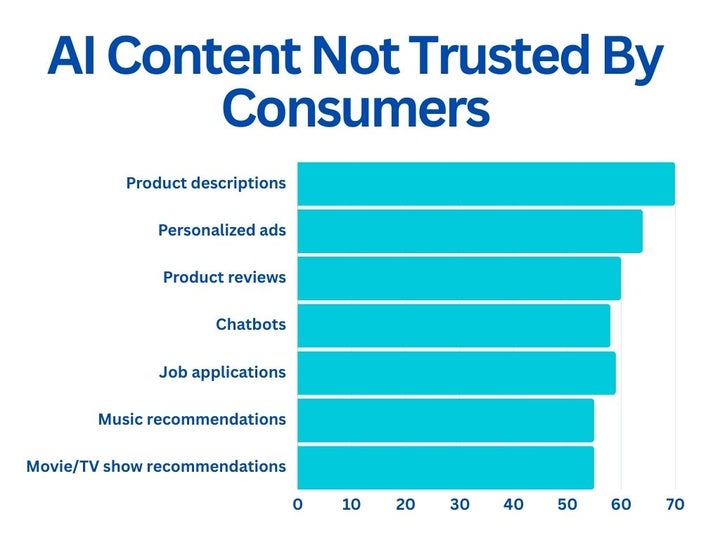
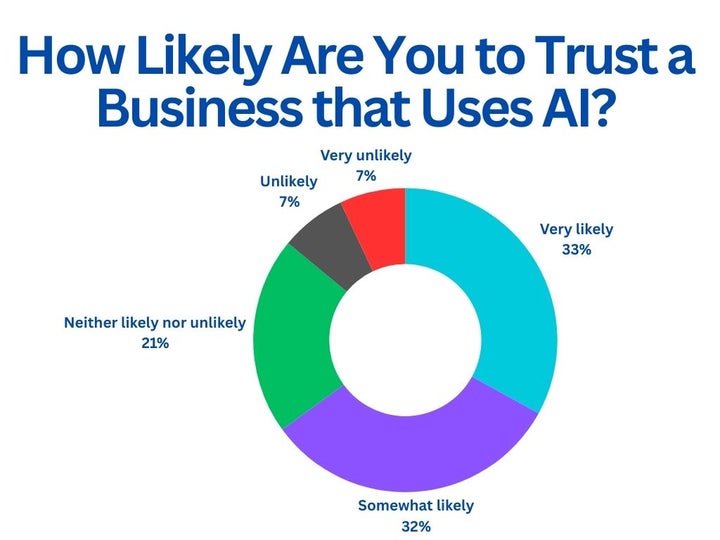
Despite the overall apprehension for this new technology, 65% of consumers state that they still trust businesses that use AI, as long as it’s done transparently. In fact, over 54% of users believe that generative AI tools such as ChatGPT are a good solution to improve previously written content.
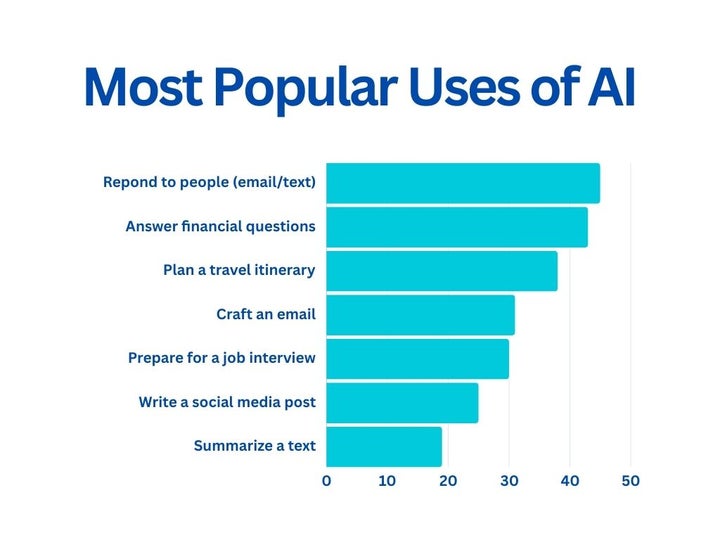
Most Popular Uses of AI in 2024
Currently, AI is mostly used to respond to people through texts and email messages as well as answering financial questions or planning travel itineraries. Other common uses are crafting emails, aiding people in job interviews, writing social media posts and summarizing lengthy texts.
Conclusion: AI has a successful present and an auspicious future
As shown by the data collected in this article, the future of Artificial Intelligence (AI) is bright and promising. This new technology aims to reshape productivity as we know it, becoming our relentless personal assistants and enhancing everyday’s work.
While AI is currently seen with apprehension due potential job displacements, if used ethically and operated transparently, it is bound to gain the public trust. Ultimately, artificial intelligence is being adopted by most businesses worldwide and its successful future is already a reality. We can only wait to see what AI holds for us.
Mireia Fernández is passionate about the world of video games and new technologies, a hobby that dates back to her childhood with the MSX HB 501p. Born and residing in Barcelona, Mireia has been working as an editor for over 10 years and specializes in writing reviews, tutorials, and software guides, as well as doing everything possible to publish news before anyone else. Her hobbies include spending hours playing on her console, walking her golden retriever, and keeping up with the latest SEO developments.
Latest from Mireia Fernández
You may also like
 News
NewsThe CEO of Take-Two fully trusts the skills of the new CEO of Xbox
Read more
 News
NewsAfter finishing his series, Jack Ryan receives the first trailer for the movie with which he says goodbye
Read more
 News
NewsDo you want to go back to physical format? Some suggest replacing DVDs with… flash drives
Read more
 News
NewsThere is a reason why 'Dune 3' seems completely different from the first two parts: it is
Read more
 News
NewsLeonardo DiCaprio has gone without an Oscar and this movie was the first in which he could have won it, but he didn't, and you can watch it streaming
Read more
 News
NewsThe first trailer for the new Jack Ryan has a John Krasinski in his element
Read more