
News
Generation Alpha Characteristics: Innovators or Trading Humanity for Technology?
These are the main stats and characteristics that define Generation Alpha


- January 30, 2025
- Updated: July 1, 2025 at 10:29 PM
Generation Alpha is the first generation born in a fully digital world. Born between 2010 and 2025, Gen Alpha’s appearance coincides with the launch of Apple’s first iPad and, along Generation Z, they have grown up in a digital environment. However, there’s a big difference between Generation Alpha and their parents (Millenials) and older siblings (Gen Z): they understand, begin to use and adapt to new technology much faster than them.
Being the newer generation, Gen Alpha is bound to shape the future as we know it. But in what ways are they going to change society? In today’s article we’re going to delve deep into the latest statistics, trends and data of Generation Alpha to get a clear picture on how technology will mould their personality and change their view of the world and what legacy will they leave to Generation Beta.

Subscribe to the Softonic newsletter and get the latest in tech, gaming, entertainment and deals right in your inbox.
Subscribe (it's FREE) ►Top Generation Alpha Stats (2025)
- More than 2.8 million Generation Alphas are being born every week.
- 65% of Gen Alphas will work in a job that hasn’t been created yet.
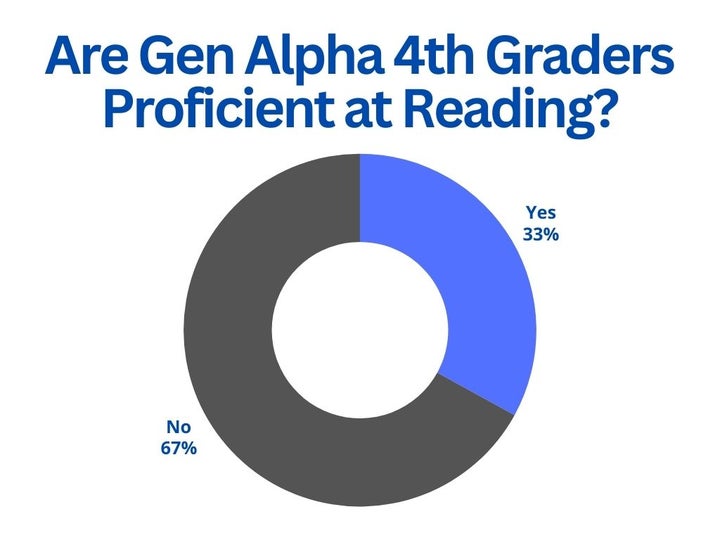
- Gen Alpha is underperforming in schools, with 67% of fourth-graders not being proficient in reading at that age.
- 49% of Generation Alphas trust Influencers as much as they trust family and friends.
- Gen Alpha will be the generation with the highest spending rate in history.
- Generation Alpha is the most diverse one in US History.
How Many Generation Alphas Are Born Each Week?
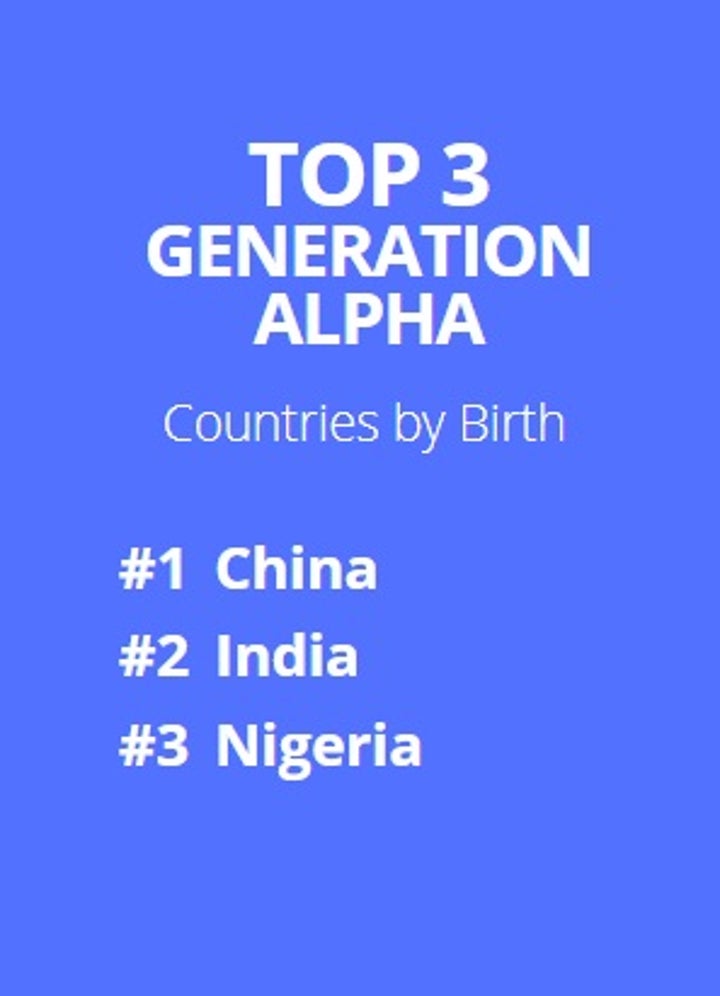
Currently, there’s more than 2 billion Gen Alphas living in the world, with China, India and Nigeria leading the top 3 countries by number of births. And these numbers are still temporary. According to a recent study made by McCrindle, more than 2.8 million Generation Alphas are born globally every week. This makes Gen Alpha the largest generation in the history of the world.
How Many Generation Alphas Are There In The US?
According to Statista, Gen Alpha comprises over 13% of the US population, with 38.55 million individuals belonging to it. While the number of Gen Alphas in the US is currently higher than those belonging to the Silent Generation or Greatest Generation, it is approximately half of the Millennial Generation.
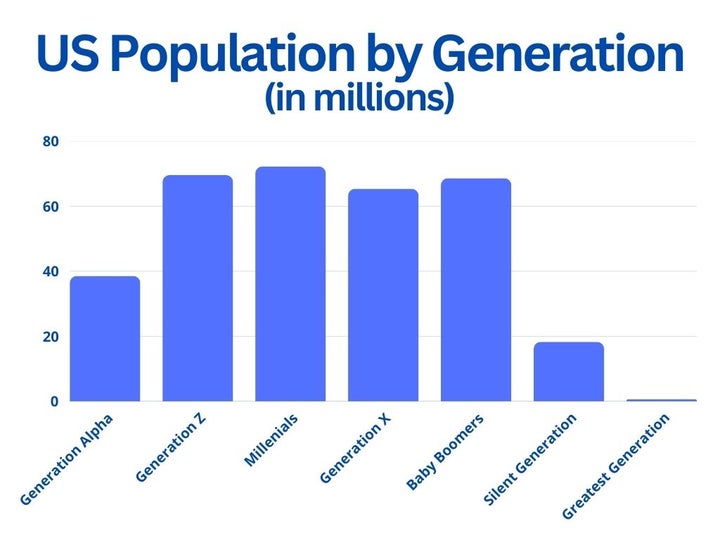
Here’s a detailed table showing the number of US citizens and their corresponding generation.
- Generation Alpha (2010-2025): 38.55 million.
- Generation Z (1997-2012): 69.58 million.
- Millennials (1981-1996): 72.24 million.
- Generation X (1965-1980): 65.37 million.
- Baby Boomers (1946-1964): 68.59 million.
- Silent Generation (1928-1945): 18.29 million.
- The Greatest Generation (1928): 0.67 million.
How Diverse Is Generation Alpha in the US?
A recent report made by Emarketer and the US Census Bureau shows how Gen Alpha is currently the most diverse generation in the United States.
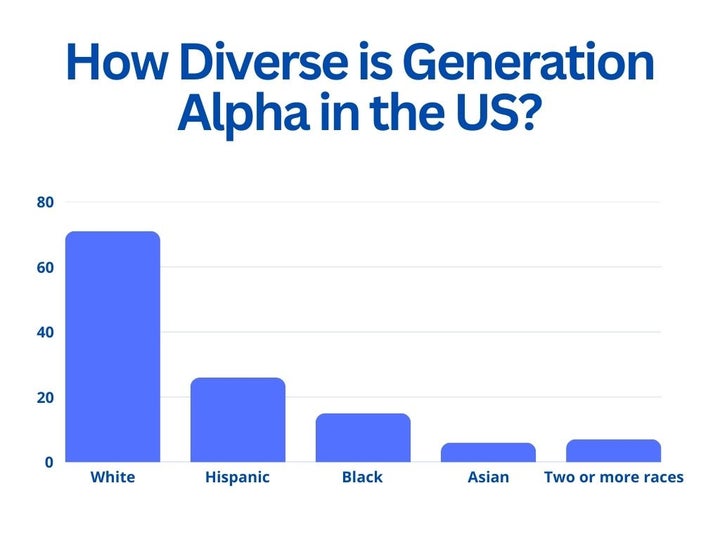
Here’s a breakdown of the results, displaying the percentage of different ethnicities of Generation Alpha in the US:
- White: 71%
- Hispanic: 26%
- Black: 15%
- Asian: 6%
- Two or more races: 7%
What Is Gen Alpha Interested In?
According to a recent survey made by Wunderman Thompson, Generation Alpha follows on Gen Z’s footsteps, wanting to make a difference in the world. In fact, 59% of them state that they would like to save lives somehow, while 51% answered they would use technology to make a difference.
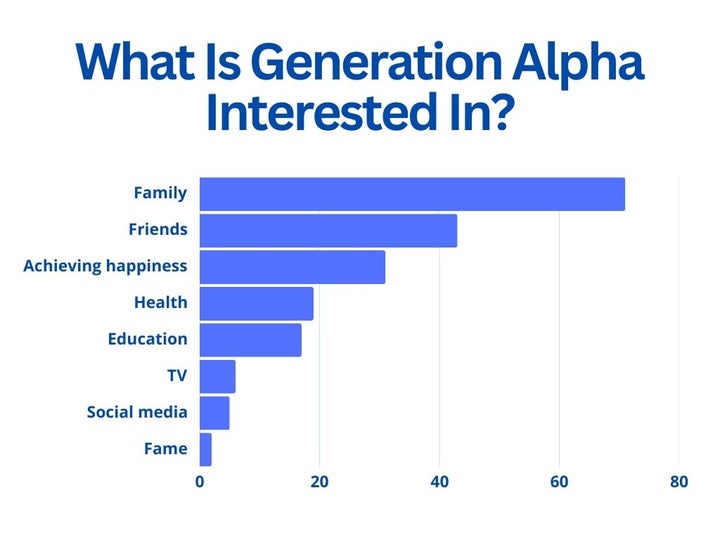
The same survey also found out that one of the most important things for Gen Alphas is family (71%), closely followed by friends (43%) and achieving happiness (31%). On the opposite end of their scale of values we find health, with only 19% of them stating that it’s important and education, with a low 17%. Closing the list of things they believe that are important we find TV (6%), social media (5%) and fame (2%).
How Socially Aware is Generation Alpha?
Like Gen Z, Generation Alpha has a strong sense of awareness as well as engagement with social issues such as gender diversity, race, climate changes and sustainability. According to GWI, 60% of Generation Alpha wants everyone to be treated the same way, showing extreme concern for social injustices like bullying. Having been raised in a diverse environment has helped Generation Alpha to be constantly looking for inclusivity and representation, with 30% of Gen Alphas wanting stating it’s important to show all types of people in all kinds of media.
A recent report made by Canva8 also shows how acceptance is very important to Generation Alpha. In fact, 93% of Gen Alphas aged from 7-9 stated that one of the most important things is being accepted for who they are. Also 97% of them feel that everyone should have food and 96% that everyone should have a place to live. Finally, 97% of Generation Alpha believes that everyone should be treated equally, despite racial or ethnic differences.
What Social Skills Does Gen Alpha Have?
Like Gen Z, Generation Alpha has less social abilities than previous generations, lacking direct social and communication skills. This translates into future difficulties in, for example, their workplace, where they will have a clear handicap when running a meeting, interacting with their co-workers or trying to close a deal. Not everything is bad news though. According to a recent report by GWI, Gen Alpha are still very interested in connecting face-to-face with other people, even if they are not very good at doing so.
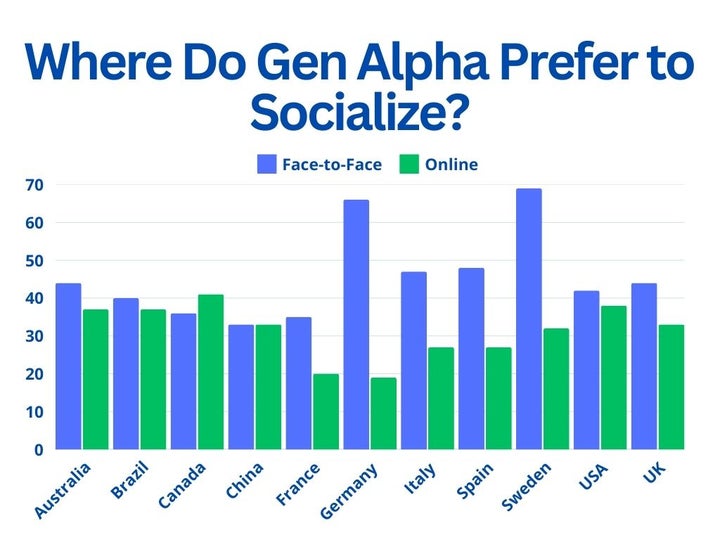
As an example, here’s a list displaying the percentage of Generation Alphas (aged between 12-15) by country who prefer seeing their friends after school than talking online to them:
- Australia- See their friends after school (44%), Talk to them online after school (37%).
- Brazil- See their friends after school (40%), Talk to them online after school (37%).
- Canada- See their friends after school (36%), Talk to them online after school (41%).
- China- See their friends after school (33%), Talk to them online after school (33%).
- France- See their friends after school (35%), Talk to them online after school (20%).
- Germany- See their friends after school (66%), Talk to them online after school (19%).
- Italy- See their friends after school (47%), Talk to them online after school (27%).
- Spain- See their friends after school (48%), Talk to them online after school (27%).
- Sweden- See their friends after school (69%), Talk to them online after school (32%).
- USA- See their friends after school (42%), Talk to them online after school (38%).
- UK- See their friends after school (44%), Talk to them online after school (33%).
Generation Alpha is Currently Underperforming in Schools
Elementary and middle school teachers are currently expressing concern about Gen Alpha’s behavior and performance in school. In a digital era and after the COVID-19 pandemic, there’s been an exponential increase in online schooling and lack of socialization. This leads to an increased difficulty in focusing, learning delays as well as issues such as ADHD, depression or even anxiety.
According to The Emory Wheel and NAEP, only 33% of fourth graders in the US scored at or over proficiency in reading, leaving 67% of them failing at these tests. This follows a continued decline in proficiency rates that had its peak in 2017. As a result, experts believe that if educational performance doesn’t improve, it will lead to significant setbacks for societal progress.
One of the culprits for this underperformance in schools is the decrease of paper-and-pencil activities as well as active investigation and learning away from the screens. A recent survey made by Qustodio backs up this matter, finding out how 72% of students globally use some kind of digital devices in their classroom. From these, 44% are provided by the school itself while 28% bring them from home.
What is the Future of Work for Gen Alpha?
With the first wave of Generation Alpha set to enter the workforce by the 2030s and technology accelerating at a rapid pace, it is entirely possible that 65% of Gen Alphas will work in jobs that don’t exist today.
If we look at current existing jobs, and keeping in mind Gen Alpha’s interest in technology, sustainability and healthcare, it is very possible the future of work for Gen Alpha will fall on these jobs:
- AI and Machine Learning specialists.
- Sustainability and Environmental engineers.
- Healthcare and Biotechnology professionals.
- Cybersecurity experts.
- Digital content creators and influencers.
- Virtual workspace designers and facilitators.
- Robotics engineers.
- Automations specialists.
How Much Time Does Gen Alpha Spend on Screens?
Being born along the launch of the iPad, Gen Alpha has been shaped by the era of portable devices such as smartphones and tablets. This translates into Gen Alpha spending more time looking at screens than any other generation.
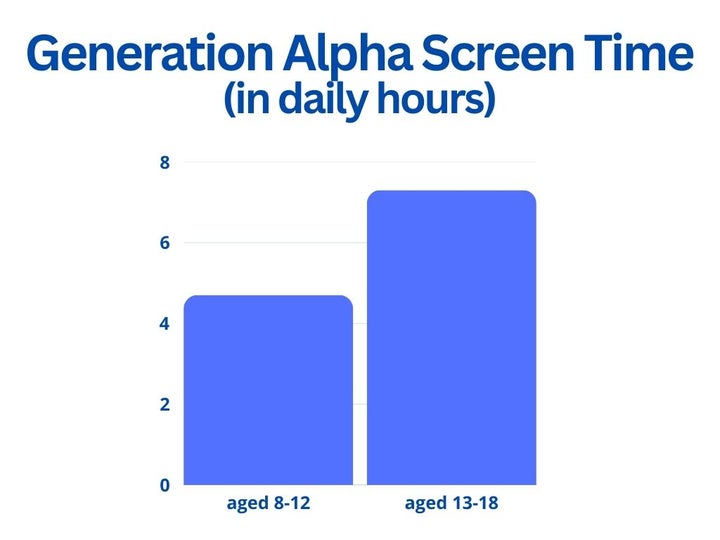
According to McCrindle’s Understanding Generation Alpha, those aged 8-12 consume an average of 4 hours and 44 minutes of screen per day just for entertainment purposes. This number increases to 7 hours and 22 minutes for those aged 13-18.
Regarding what is the preferred device used by Gen Alpha, a recent report states that 49% of Alphas own a tablet, but they spend the most time on desktop computers and using VR headsets.
What Is the Most Popular Video Streaming Service for Gen Alpha?
Currently, 50% of Generation Alpha (including 0 to 4 year-olds) use video streaming services on a daily basis. 60% of Gen Alphas use YouTube to watch videos and, from this, 90% use it on a daily basis, spending an average of 84 minutes on the platform. On second position we find Disney+, with 54% of Gen Alphas accessing the platform to watch their favorite videos and shows.
What Is the Most Popular Social Media Platform for Gen Alpha?
Growing at an explosive rate YoY (+18%), TikTok is the most popular social media app for Generation Alpha. The platform has overtaken giants such as Facebook, Instagram or WhatsApp and 1 in every 5 Gen Alphas agree that TikTok is their favorite app to access social media posts.
What Are Gen Alpha’s Favorite Video Games?
A survey made by GWI shows how Generation Alpha prefers online games which involve socialising and building and/or creating their own spaces. As data shows, 58% of Gen Alphas play Minecraft on a monthly basis, closely followed by Roblox (43%) and Fortnite (40%).
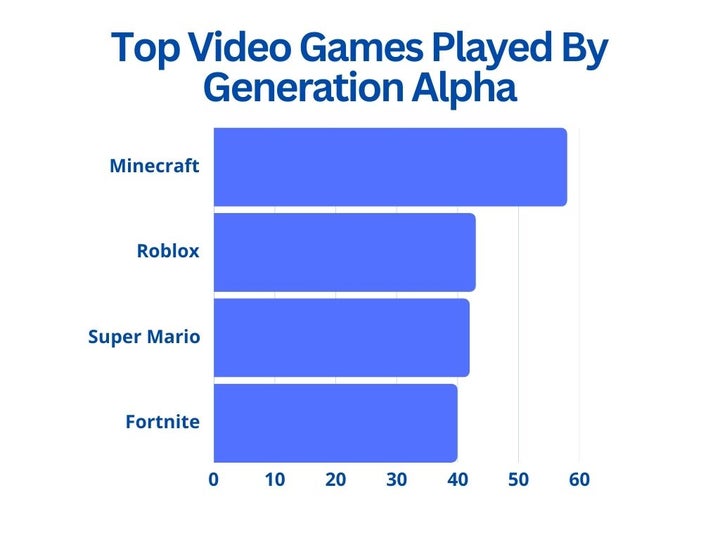
Here’s a breakdown of the results:
- Minecraft- 58%
- Roblox- 43%
- Super Mario- 42%
- Fortnite- 40%
Regarding video game genres, Gen Alphas enjoy the most adventure games (55%) as well as those that include building or creation features (43%).
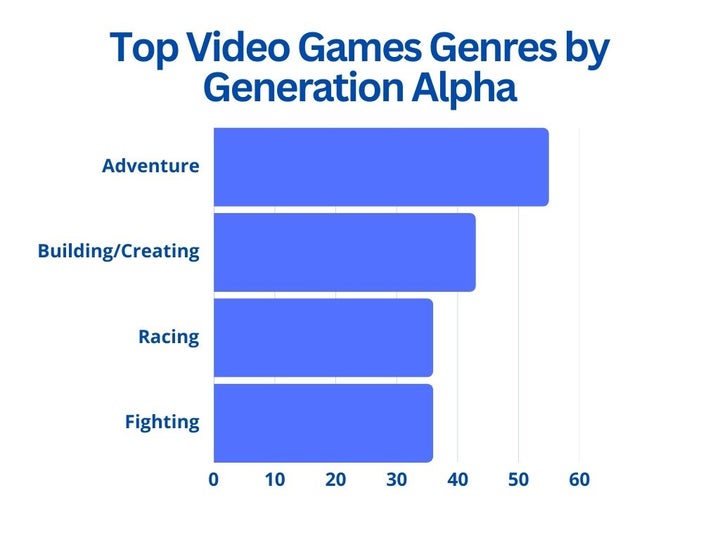
Here’s a table with the main results of the survey:
- Adventure- 55%
- Building/creating- 43%
- Racing- 36%
- Fighting- 36%
Conclusion
Generation Alpha is the largest generation in history and the first one surrounded by a fully digital world. Growing hand-to-hand with touch-screen devices as well as remote learning during the COVID-19 pandemic has affected their behavior, as well as the way they learn and interact with their peers. Independent, permanently connected and being shaped by new technologies, Generation Alpha is set to change our sense of environmental and social awareness in the years to come.
Mireia Fernández is passionate about the world of video games and new technologies, a hobby that dates back to her childhood with the MSX HB 501p. Born and residing in Barcelona, Mireia has been working as an editor for over 10 years and specializes in writing reviews, tutorials, and software guides, as well as doing everything possible to publish news before anyone else. Her hobbies include spending hours playing on her console, walking her golden retriever, and keeping up with the latest SEO developments.
Latest from Mireia Fernández
- Google Drive as Your Professional Second Brain: How to Build a Digital Vault for Every Project, Client, and Deliverable
- How to Keep Your Windows PC Running Smoothly With Regular Checkups in CCleaner Free
- Mastering the New Google Workspace: 5 Gemini AI Tricks You Didn’t Know You Could Do
- From Idea to Execution: Using Adobe Stock Across Multiple Creative Tools
You may also like
 News
NewsHow to Edit Videos for YouTube and TikTok with Adobe Premiere Pro
Read more
 News
NewsHow to Improve and Sharpen a Blurry Photo in Photoshop
Read more
 News
NewsNicolas Cage is the most unique and suggestive Spider-Man we have ever seen
Read more
 News
NewsMarathon will be free-to-play for a limited time after the closure of Destiny 2
Read more
 News
NewsStephen King considers the new series by the Duffer brothers "a true delight"
Read more
 News
NewsThe developers of the currently most popular battle royale are asking you not to buy their game
Read more