
News
Is Cable TV Dying? The Collapse is Accelerating, So What’s Next?
These are the latest cord-cutting stats and trends in 2025


- February 18, 2025
- Updated: July 1, 2025 at 10:22 PM
Traditional TV, as we know it, is slowly dying. With a $5 billion revenue fall expected by the end of 2029, pay-TV subscriptions are losing their charm among viewers. With streaming services on the rise, over 80.7 million households in the United States are forecasted to use non-pay TV by the end of 2026. And the high cost of traditional TV seems to be just the tip of the iceberg of this growing dissatisfaction among TV watchers. So… Why is this cord-cutting exodus becoming more and more appealing each year?
In today’s article we’ll explore the latest cord-cutting stats available in 2025, delving deep on the reasons for cord-cutting and the impact resulting in the way we watch and understand TV.

Subscribe to the Softonic newsletter and get the latest in tech, gaming, entertainment and deals right in your inbox.
Subscribe (it's FREE) ►Top Cord-Cutting Statistics (2025)
- There will be 80.7 million cord-cutting households in the US by 2026.
- The average cord-cutter is 35-55 years old.
- Over half of Americans who dropped cable TV subscriptions say they don’t miss it.
- Satellite TV providers have lost over 20 million US subscribers since 2014.
- There will be 1.68 billion global streaming video on demand subscriptions by 2027.
- 30% of Americans with cable TV are thinking of cancelling this service.
- 59.6 million households in the US have switched to non-pay TV
- 86.7% of people reported to drop cable TV due to the high price.
- Pay TV revenue is expected to drop from 58.2 billion in 2023 to 43.6 billion in 2029.
How Many People Are Cutting the Cord in 2025?
According to eMarketer, it is expected that by the end of 2025, 77.2 million Americans will cut the cord and cancel their satellite and cable subscriptions. This represents a 4 million increase since 2024, and the trend isn’t going to stop anytime soon. By the end of 2026, it is forecasted that the numbers are going to increase to 80.7 million non-pay-TV households in the US.
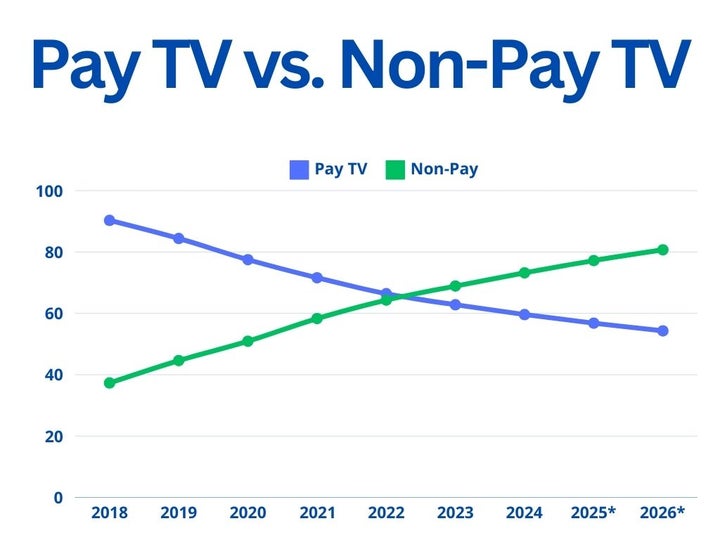
Here’s a detailed breakdown of the results, showing the number of pay TV households versus those that decided to cut the cord of their TV and satellite subscriptions:
- 2018- Pay TV: 90.3 million, Non-Pay-TV: 37.3 million.
- 2019- Pay TV: 84.4 million, Non-Pay-TV: 44.6 million.
- 2020- Pay TV: 77.5 million, Non-Pay-TV: 50.9 million.
- 2021- Pay TV: 71.6 million, Non-Pay-TV: 58.3 million.
- 2022- Pay TV: 66.4 million, Non-Pay-TV: 64.3 million.
- 2023- Pay TV: 62.8 million, Non-Pay-TV: 68.9 million.
- 2024- Pay TV: 59.6 million, Non-Pay-TV: 73.2 million.
- 2025*- Pay TV: 56.8 million, Non-Pay-TV: 77.2 million.
- 2026*- Pay TV: 54.3 million, Non-Pay-TV: 80.7 million.
(*estimated)
75% of U.S Households Won’t Have a Traditional TV Subscription by 2026
A recent survey made by Statista shows how over 60% of the US households dropped their traditional TV subscription by the end of 2023. The numbers experienced an increase in the following years, fueled by the fact that 64% of American adults have some sort of live pay-TV service. It is expected that by the end of 2025 the number of cord-cutters in the United States will rise to 75%.
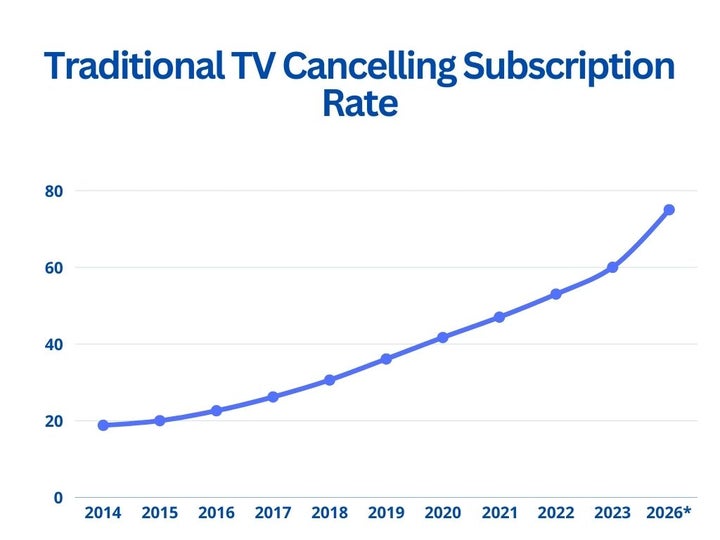
The following data shows the share of households in the US who have cancelled their traditional TV subscription:
- 2014- 18.8%
- 2015- 20%
- 2016- 22.6%
- 2017- 26.2%
- 2018- 30.6%
- 2019- 36.1%
- 2020- 41.7%
- 2021- 47%
- 2022- 53%
- 2023- 60%
- 2026*- 75%
(*estimated)
How Many People Still Have Cable TV?
There’s currently 66.1 million cable TV subscriptions in the US, which represents a whopping decline of 8% from 2023. As seen by the data, the numbers of TV subscribers decrease at a higher rate YoY, emphasizing the increase of cord-cutters through the county.
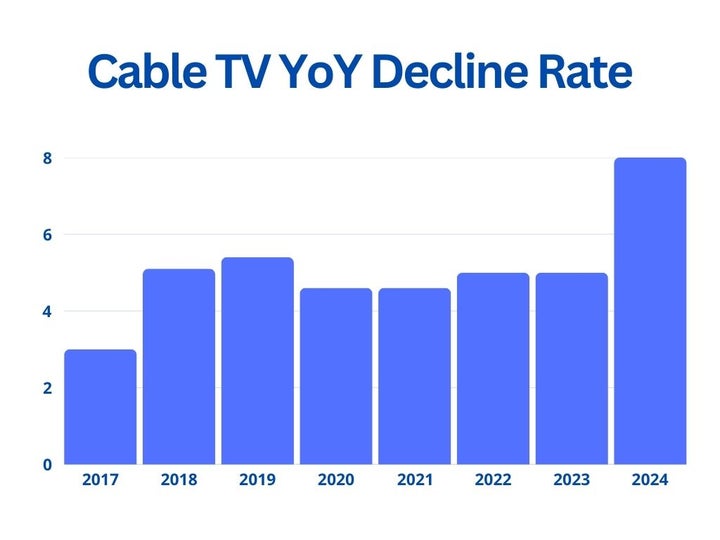
Here’s a detailed breakdown of the results, showing the YoY decline:
- 2017- 96.3 million (3% decline)
- 2018- 93.4 million (5.1% decline)
- 2019- 88.6 million (5.4% decline)
- 2020- 83.8 million (4.6% decline)
- 2021- 80 million (4.6% decline)
- 2022- 76 million (5% decline)
- 2023- 72.2 million (5% declin+e)
- 2024- 66.1 million (8% decline)
Pay TV providers have lost over 20 million US subscribers since 2014
The cord-cutting boom in the US can be translated into a massive exodus of cable tv subscribers to other sources of entertainment. As recorded by Statista, US cable and satellite providers have been losing customers at an alarming rate since 2014. As seen by the trend, pay TV companies are losing more and more subscribers every year, while video streaming companies are flourishing with earnings.
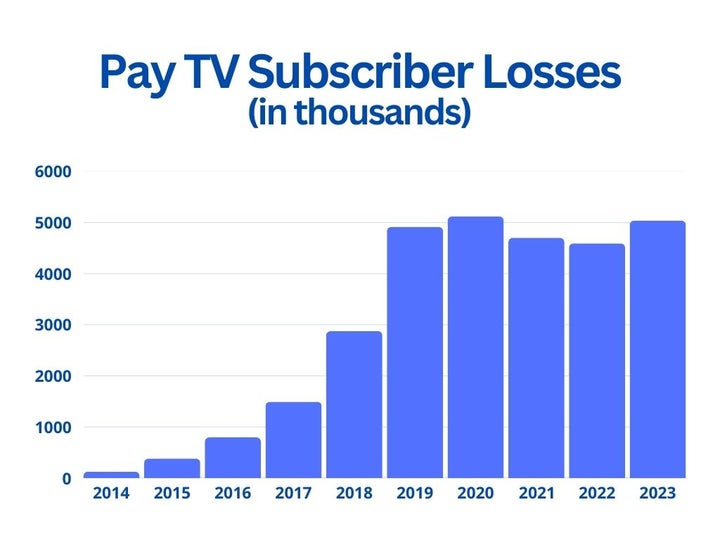
Here’s a detailed breakdown of the total subscriber losses for pay TV companies from 2014-2023:
- 2014- 125.78K
- 2015- 383.47K
- 2016- 796.9K
- 2017- 1,493.25K
- 2018- 2,874.47K
- 2019- 4,913.96K
- 2020- 5,118.63K
- 2021- 4,698.24K
- 2022- 4,590K
- 2023- 5,035K
Why Do People Cut the Cord?
Saying goodbye to standard pay TV seems to be an established trend for the years to come, but what is the main reason for cord-cutting? According to a study made by Broadband Search, the majority of people worldwide (86%) are cancelling their Pay TV and satellite subscriptions to save money, since traditional TV is more pricey than acquiring a SVOD subscription. 20% of cord-cutters also stated that they decided to switch to streaming due their preference to these platforms, while 23% of them prefer going back to antenna TV.
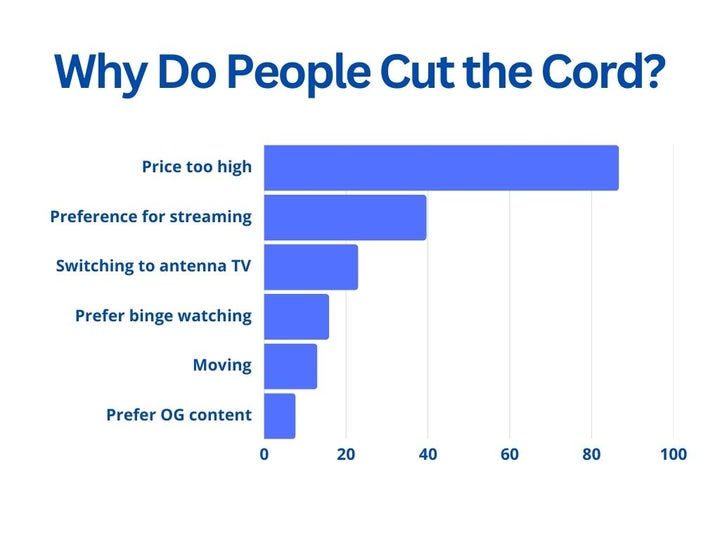
Here’s a detailed table why people are switching their traditional cable services:
- Price- 86.7%
- Preference for streaming- 39.7%
- Switching to antenna TV- 23%
- Prefer binge watching- 15.9%
- Moving and not wanting to renew the services- 13%
- Prefer original content on streaming platforms- 7.7%
Cord-Cutting by Age Group (2025)
A recent survey made by Statista shows how 10% of the U.S population is extremely likely to cancel their pay TV subscription in the next 12 months. Among them, the keenest to cut the cord were individuals aged between 35 and 54 years old. In contrast, people 55 or over showed no interest in cancelling their TV subscription in the coming year.
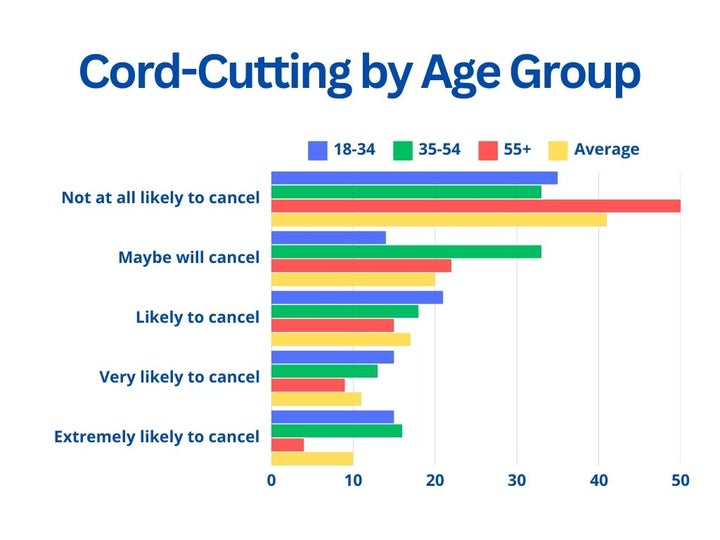
Here’s a detailed list of the survey’s results:
- Not at all likely to cancel: 18-34 (35%), 35-54 (33%), 55+ (50%) Average (41%)
- Maybe will cancel: 18-34 (14%), 35-54 (33%), 55+ (22%), Average (20%)
- Likely to cancel: 18-34 (21%), 35-54 (18%), 55+ (15%), Average (17%)
- Very likely to cancel: 18-34 (15%), 35-54 (13%), 55+ (9%), Average (11%)
- Extremely likely to cancel: 18-34 (15%), 35-54 (16%), 55+ (4%), Average (10%)
Impact of Cord-Cutting
The impact of cord-cutting can easily be seen through the slow decrease in revenue from Pay TV services. According to Statista, Pay TV revenue has dropped from $100.09 billion in 2017 to $83.42 billion in 2025. That’s a 16.6 billion difference in less than a decade.
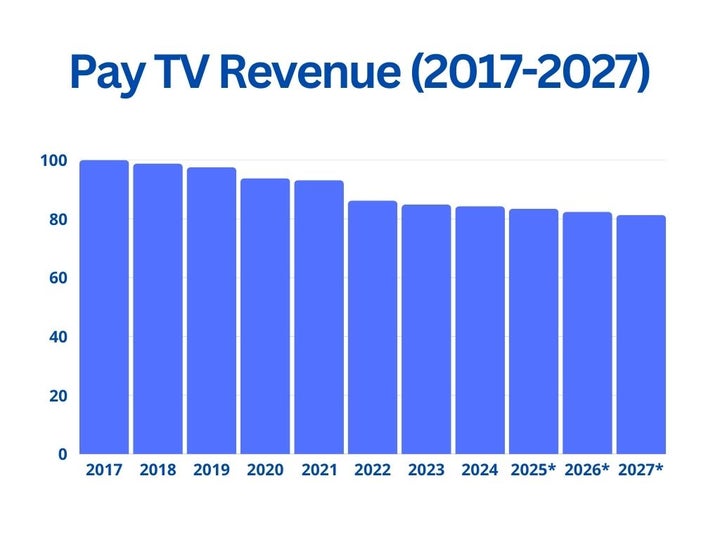
Here’s a table showing the evolution of pay TV revenue from 2017-2027.
- 2017- 100.09 billion.
- 2018- 98.81 billion.
- 2019- 97.53 billion.
- 2020- 93.83 billion.
- 2021- 93.17 billion.
- 2022- 86.21 billion.
- 2023- 84.89 billion.
- 2024- 84.29 billion.
- 2025*- 83.42 billion.
- 2026*- 82.39 billion.
- 2027*- 81.33 billion.
(*estimated)
There will be 1.68 billion global SVOD subscriptions by 2027
Streaming video on demand platforms have experienced an exponential growth due the increasing global trend of cord-cutting, with 99% of the U.S household are subscribed to at least one of these services. According to Digital TV Research, SVOD subscriptions will increase by 475 million between 2021 and 2027. These will be mostly distributed among Netflix (251 million), Prime Video (250 million), Disney+ (207 million), Paramount+ (82) and Max (77 million).
Conclusion
Cord cutting is increasing year over year, with millions of consumers switching their cable and pay TV subscriptions for SVOD platforms. This has drastically impacted the cable television industry, which currently gets most of their revenue due live sports and broadcasted entertainment events. However this doesn’t mean that standard Pay TV is dead, but trends definitely point to a change in the years to come.
Mireia Fernández is passionate about the world of video games and new technologies, a hobby that dates back to her childhood with the MSX HB 501p. Born and residing in Barcelona, Mireia has been working as an editor for over 10 years and specializes in writing reviews, tutorials, and software guides, as well as doing everything possible to publish news before anyone else. Her hobbies include spending hours playing on her console, walking her golden retriever, and keeping up with the latest SEO developments.
Latest from Mireia Fernández
You may also like
 News
NewsThe new strategy from Universal that will help the survival of movie theaters
Read more
 News
NewsNetflix is preparing a series about the tumultuous life of Frida Kahlo
Read more
 News
NewsThe most iconic family series of the 2000s is back, and we can already see its trailer
Read more
 News
NewsThe most beloved and at the same time most hated character from Family Guy will have his own spin-off
Read more
 News
NewsNetflix confirms the sequel to K-pop Warriors by the original creative team
Read more
 News
NewsThe Yellowstone spin-off has been so well received that a second season has already been confirmed
Read more