
News
The Software Behind the Success of Zootopia 2: How Autodesk Maya and Flow Production Tracking Brought It to Life
A technical ecosystem capable of sustaining 2 055 shots, 178 unique characters, more than 8 000 modelled elements and 700 artists working like a single organism

- March 25, 2026
- Updated: March 25, 2026 at 8:06 AM
With Zootopia 2, Walt Disney Animation Studios has taken large-scale animation to a whole new level. Blending creativity with technology, we are looking at a film that is simply astonishing. A film overflowing with detail, references and humour, and one that shows it in its script, its dialogue, its sets and in every character that inhabits them. When a film consists of more than 2 055 shots, 178 unique characters, and requires more than 700 professionals working in coordination over several years, the final result is as much a product of artistic talent as it is of the quality of the software that, when it does its job well, fades into the background while supporting the entire process.
Some films expand a story and others expand an entire universe. In the case of Zootopia 2, the city, the characters, the settings and the volume of information all grow exponentially and at the same time, meaning that the scale of production changes completely. This is where Autodesk Maya and Flow Production Tracking become essential parts of the film’s very production language.
When we go to the cinema to watch Zootopia 2, the first thing we see is the expressiveness of the characters, the richness of the sets and the natural way in which every space comes to life, but behind all of that there is another universe that is just as important: the invisible organisation that keeps the entire feature moving. Let’s talk about how Disney Animation used Maya to build worlds and Flow Production Tracking to turn an immense production into a fluid, connected and highly precise process capable of taking what a film can be to another level.
The biggest, densest and most vibrant city to date
From its conception, Zootopia 2 was designed to go well beyond the original film. The sheer scale of the project makes that more than clear: 41 sequences, 2 055 shots, a total running time of 97 minutes and 30 seconds, and a film that, using stereo 3D, reaches 288 710 rendered frames. Astonishing numbers, but let’s put them into context.
If we think about what it means to build an entire virtual city practically from scratch, we immediately understand why the simple geometry of this production required a different approach. In animation, every building, every market stall, every background object and every decorative element is created from zero, passes through several hands and, by the end, without even counting revisions and improvements, has to fit precisely into a huge ecosystem. In Zootopia 2, that process is repeated for each of the more than 8 000 modelled elements.
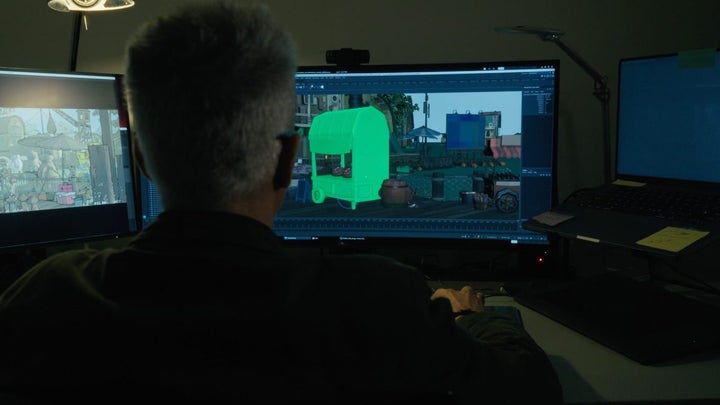
The clearest example of that growth can be found in Marsh Market, an environment whose scale, density, detail and performance demand an especially careful approach. As the production leads explain in the video from a few paragraphs above, they found themselves facing a setting that required volume, visual richness and great agility to iterate at top speed in order to keep up with the pace of the creative teams striving to refine a scene until they found exactly the right tone. This is where Maya comes into play.
Autodesk Maya: the tool that brings an entire universe to life
Autodesk Maya’s greatest strength here has a lot to do with something that sometimes goes unnoticed when we talk about software: intuitive work. For a team that has to model, block scenes, set up cameras, prepare layouts and connect departments, working in a well-structured tool makes an enormous difference. According to the production team itself, Maya offers exactly that, a versatile foundation for building complex environments naturally, something essential when the project is growing in every direction at once.
That versatility is key when we talk about Maya as a kind of connective tool between departments. In Walt Disney Animation Studios films, environment modelling, layout, animation, simulation and staging constantly feed into one another. Every adjustment, tweak or change has an impact on several areas, every shot carries information into the next, and every department needs to be able to access the decisions that have already been made so that its work can be efficient.
Lastly, there is something especially interesting about Maya that deserves to be highlighted: the ability to customise the toolset itself. Faced with a film that brings together such different, and rather unusual, species, scales and proportions, software that opens the door to extensions and bespoke developments is crucial. The people behind this production explain how the team relied on that extensibility to create several specialised utilities, including a scale-auditing tool for Gary De’Snake, allowing them to adapt the pipeline to certain specific needs.
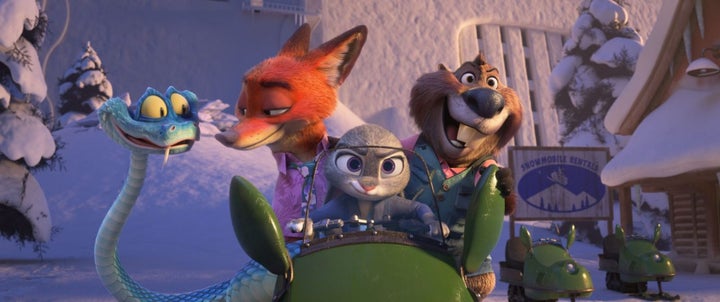
All in all, the visual grandeur of Zootopia 2 begins long before the final lighting or the definitive render. It begins in the way spaces are built, proportions are tested, the elements that appear on screen are organised and the decisions are connected across every creative area. That is why talking about production means talking about Maya, because we are going far beyond modelling or animation: we are talking about a creative environment that sustains the growth of the entire film.
A pipeline that grows in every dimension and says goodbye to linearity
We have talked about sets and animation and we have seen where Autodesk Maya fits into that part of the equation, but that is only half the story, in every sense. The production process, the organisation and the joint evolution of every department pass through Maya in terms of results, but in terms of planning and tracking they pass through Flow Production Tracking.
For years, the most widespread image of an animation pipeline looked very much like a straight line: one department delivers, the next receives, and the project moves forward in more or less sequential stretches. In a production on the scale of Zootopia 2, and in many Walt Disney Animation Studios productions, that logical progression gives way to a far more interwoven dynamic, because creative changes occur throughout the film’s development and call for a different kind of evolving structure.
When excellence is the goal, the process itself feeds back into the basic structure of the film, which is why, at the studio that brought Mickey Mouse to life, the script continues to undergo changes and adjustments until shortly before production ends.
From the development team to the post-production team, every department participates in building the overall picture. In different layers and in different ways, each one touches the film’s entire content. These changes, whether they come from editorial, story, visual development, asset creation, layout, animation, technical direction, lighting or production, have to be recorded, tracked and, as far as possible, predicted and planned.
The pipeline cannot be linear. A rigid relay-chain would not produce the result we see in Zootopia 2 or in other productions from the studio, simply because it is impossible to plan the entire production from the outset. What is needed is a shared data environment where changes can spread quickly and where several departments enter the conversation earlier. The result is a project that moves forward with greater flexibility and with a much more precise reading of the film’s real status while the creative areas continue developing the story.
Yvett Merino sums it up very well when she explains that the team keeps working on the story while it is creating it, with editorial decisions directly affecting tasks that are already underway at the studio. That constant flow requires tools capable of absorbing adjustments, redistributing information and keeping hundreds of artists aligned.
Why? Because every single person working on the production has to be able to do so with a connected view of the project and of the supervisors’ and directors’ notes. When layout, modelling, production and direction share common ground, iterations move forward with greater quality, clarity and a much fuller understanding of the objective.
The idea of “higher quality, faster iterations” that appears in Disney Animation’s process is the key to understanding how a film like the one we are discussing gets made. Here, speed is very visibly in the service of quality, and it does so thanks to a working infrastructure that enables exchange and dialogue between all the areas involved. We have to talk about Flow Production Tracking.
Flow Production Tracking: the film’s invisible operating system
If Maya is essential for building the worlds of Zootopia 2, Flow Production Tracking is the foundation that allows them to move, be organised and stay coordinated. With more than 2 000 shots, thousands of elements and around 700 artists involved, the production needs a system capable of translating the feature’s overall vision into specific daily tasks. That is where Flow Production Tracking stands out, as a kind of operating system for the entire project.
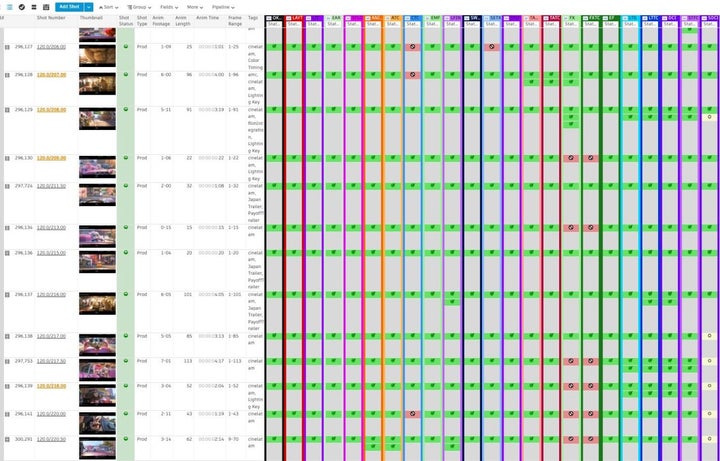
In a film of this scale, every artist has to know clearly what they are supposed to do today, which version of the scene or shot is current, what dependencies are being carried forward and how their work fits into the rest of the sequence. At the same time, supervisors, producers and directors need to be able to observe the film from another level: which sequences are progressing as planned, where pressure is building up, whether technical or creative, which teams need support and which adjustments are ultimately going to reshape the schedule. The magic of a good production-tracking system lies in bringing those two scales together within a single platform.
That explains why Autodesk Flow Production Tracking is so important. Its role goes far beyond marking tasks as completed or listing assets. In a production this alive, it acts as the nerve centre connecting departments, reflects the latest changes, organises priorities and maintains an up-to-date picture of the film’s status. When the story evolves, production needs that change to land as quickly as possible, immediately if it can, across the entire workflow.
There is one especially interesting aspect of Flow Production Tracking when it comes to visibility: the ability to detect bottlenecks before they can slow the process down. Blockages rarely appear in isolation, because they tend to spread, affect several areas and disrupt the pace of a whole sequence. Having real-time reporting makes it possible to identify those potential tensions in advance, reorganise resources and make decisions more efficiently. Data, colder by nature, becomes the core of the team’s creative momentum, because each day of production moves an enormous amount of interdependent work.
The data-guided creativity approach we see in Autodesk’s Flow Production Tracking fits especially well at the studio behind major hits such as Moana, Encanto and Frozen because it respects the artistic nature of the film. It does not replace the artists’ intuition or the directors’ eye; rather, it creates the context in which those qualities can operate more effectively. When the production team knows precisely where the film stands, what it still needs and what impact each adjustment will have, the creative team can focus more clearly on what matters.
The product is far more than the sum of its parts
If Zootopia 2 is far more than the sum of the individual contributions of everyone involved, then on the technical side the connection between Flow Production Tracking and Maya is crucial. While Maya supports the construction of the content, Flow Production Tracking supports the circulation of that content throughout the studio. One creates, the other synchronises; one allows the visible world to be iterated, the other organises the invisible film that makes every improvement and change possible.
From this perspective, we understand much better why a current blockbuster like Zootopia 2 looks far more like a network than a straight line. Every shot belongs to a sequence, every sequence belongs to a narrative, every asset touches multiple departments, and every creative change, whether in technical animation or lighting, has a translation in the very context of the story. With Autodesk’s tools, we have both the creative tools and the structural tools needed to ensure that this networked production remains readable and manageable, even at moments of maximum pressure. Order drives creativity, and we can see the results from the very first sequences.
A large part of a blockbuster’s success is decided in that invisible layer. The audience will remember a chase, a glance, a setting or the charisma of a character, and that is exactly what should happen. At the same time, behind those moments live thousands of decisions involving tracking, versioning, scheduling, validation and coordination that made it possible for the shot to exist as a faithful reflection of the directors’ intent.
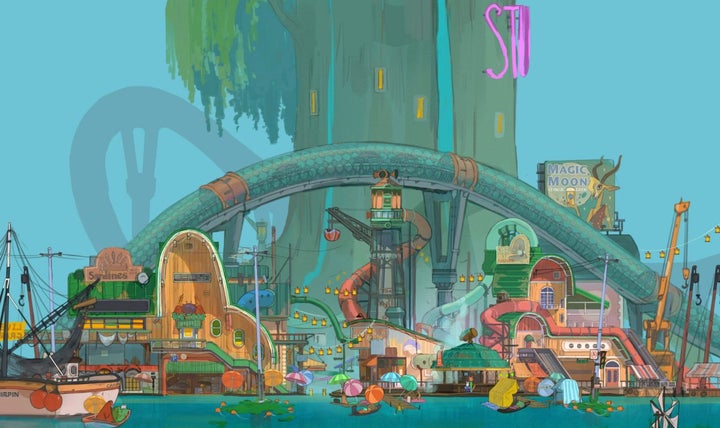
That is why it is so interesting to look at this film from the point of view of the software that supports it. Autodesk Maya provides the flexibility, power and extensibility needed to build a richer, more populated and also more demanding universe. Flow Production Tracking provides the common foundation that allows hundreds of artists to work with an aligned vision, detect potential risks in advance and keep the “production monster” moving forward even in the middle of major creative changes. The achievement lies in how both tools support human work and allow imagination to grow from order and with clarity.
The film’s success rests on charming characters, extraordinarily rich staging and the excellence of Walt Disney Animation Studios, of course. It also rests, however, on something less visible but already decisive from the very first films Walt himself worked on: a technical capability that pushes the limits of storytelling. A technical ecosystem, in this case, capable of sustaining 2 055 shots, 178 unique characters, more than 8 000 modelled elements and 700 artists working like a single organism, like the very city that gives the film its name. That is where Maya and Flow Production Tracking truly take centre stage, and where we understand that, in animation, software is part of the art.
Architect | Founder of hanaringo.com | Apple Technologies Trainer | Writer at Softonic and iDoo_tech, formerly at Applesfera
Latest from David Bernal Raspall
- The Web You Remember Is Waiting Here: Share Your Memory and Win a Trip to Switzerland
- Wonder 3D in Autodesk Flow Studio levels up the game: check out the AI that models anything in seconds
- The iPhone Fold has leaked: These could be Apple’s foldable specs
- OpenAI Launches ChatGPT Translate: Google Translate’s Competition?
You may also like
 News
NewsThe studio behind Splitgate is working on a game inspired by Titanfall and Call of Duty: Black Ops 3
Read more
 News
NewsStephen Colbert will make a new movie of The Lord of the Rings together with Peter Jackson
Read more
 News
NewsThe lead actor of the Reacher series was accused of attacking one of his neighbors, but the Police Department already has a verdict
Read more
 News
NewsOpenAI will shut down all its video generation services after losing one billion dollars
Read more
 News
NewsThe showrunner of The Boys asks us to adjust our expectations: the final episode will not be The Avengers
Read more
 News
NewsThe gacha in Destiny changes its system to be less gacha
Read more